Claire sat in the med bay, hands trembling around a paper cup of water. The medic on duty had offered to stay, but she’d asked for privacy. She could still hear the sirens outside, the clipped radio chatter, the rising tension that rippled through every hallway.
When the door opened, she expected to see a nurse or maybe one of the MPs. Instead, General Roth stepped inside.
He removed his cap, set it gently on the counter, and pulled up a chair beside her. The motion was almost human, almost kind.
“Sergeant,” he said softly. “You’re safe now. But I need you to tell me exactly what happened.”
She tried to speak, but her throat closed up. The words came out fractured, halting.
“It was last night, sir. Captain Mills called me into his office. Said he needed to go over medical reports. I thought it was routine.”
Roth didn’t move, didn’t breathe.
“He started asking about my personal life. About my deployment file. I told him it wasn’t appropriate, and he—” Her voice broke. “He grabbed my arm. I tried to pull away. He hit me.”
Silence. Just the soft hum of the fluorescent lights.
Roth’s jaw tightened, his knuckles whitening as he clenched his hands together. “Did anyone else see this?”
“No, sir. He told me no one would believe me. Said he could end my career if I said anything.”
Roth stood up slowly, his height filling the small room. “He was wrong,” he said.
By the time Captain Mills was escorted into the general’s office, the man already knew he was in trouble. He tried to play it cool — adjusted his uniform, forced a smile.
“Sir, you wanted to see me?”
Roth didn’t look up from the file in front of him. “Close the door, Captain.”
Mills obeyed, the faint trace of arrogance still in his stride.
“I’ve received a report,” Roth began. “Concerning misconduct. Against a subordinate.”
Mills’s smile faltered. “Sir, if this is about Sergeant Davis, she’s mistaken. She came into my office—”
Roth’s fist slammed down on the desk. The sound cracked like thunder.
“Do not finish that sentence,” he said, voice low and shaking with controlled fury. “You’re suspended from duty effective immediately. MPs will escort you to the holding facility until JAG arrives.”
Mills blinked, stunned. “Sir, you can’t—”
“I can,” Roth said, standing. “And I will. You’re relieved of command. Now get out of my sight before I forget what restraint looks like.”
The MPs moved in, their faces unreadable. Mills struggled, sputtering protests about rank and procedure, but none of it mattered.
As they dragged him out, Roth’s voice followed him like a sentence.
“You dishonored this uniform, Captain. And I don’t forgive dishonor.”
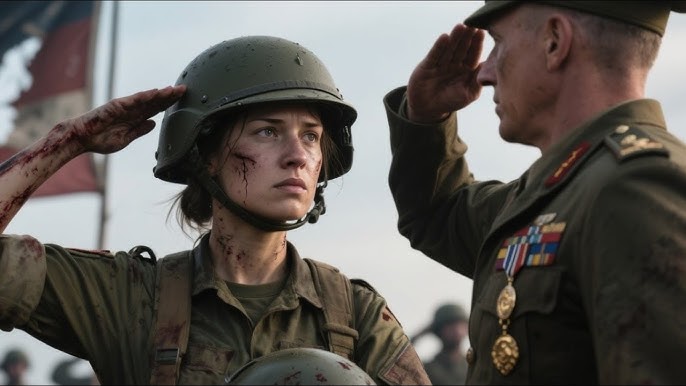
Word spread through the base like wildfire. No one spoke of it openly, but whispers carried through every barrack, every corridor. The general had personally arrested a captain — and for the first time in years, soldiers felt something unexpected: respect that bordered on reverence.
Claire avoided the mess hall for two days, embarrassed by the attention. When she finally returned, conversations quieted again — but not out of fear this time. Soldiers rose from their seats, one by one, until the whole hall stood in silent acknowledgment as she passed.
She didn’t know where to look. She wanted to disappear, but instead, she nodded once, holding her head high.
General Roth was watching from the doorway. He didn’t say a word. He didn’t need to.
That evening, Roth sat alone in his office, the light of the setting sun cutting through the blinds in long golden lines. He opened a file on his desk — Sergeant Claire Davis: commendations, medical citations, service record impeccable.
He’d seen soldiers like her before. Brave. Stoic. Willing to take pain in silence rather than risk their career. But it hit him harder than he expected. Maybe because she reminded him of someone — his own daughter, who had joined the Corps five years earlier, and who, he realized now, could have faced the same danger.
He picked up the phone. “Get me the Division Commander,” he said. “I’m initiating a review of all harassment protocols on this base. And I want mandatory ethics briefings for every officer under my command. Starting tomorrow.”
“Yes, sir,” came the reply.
“And,” Roth added, his voice lowering, “I want Sergeant Davis transferred to my staff. Effective immediately. She’ll oversee medical readiness and personnel welfare.”
A pause on the line. “Sir… is that standard procedure?”
“It is now,” he said, and hung up.

Weeks later, the investigation was complete. Mills was dishonorably discharged, facing charges that would end not only his career but his freedom. The official report never made headlines, but among the soldiers, the story lived on — a reminder that not all generals were made of cold brass and protocol.
One morning, Claire stood outside the General’s office, a folder in hand. She knocked.
“Come in,” came his voice.
She entered, saluted. “Sir, I’ve compiled the updated personnel wellness logs. And… thank you.”
Roth looked up. “For what, Sergeant?”
“For believing me,” she said simply.
He leaned back in his chair, studying her. “You didn’t need belief,” he said. “You needed justice.”
She smiled faintly. “Still… it means a lot.”
Roth nodded once, then gestured to the chair across from him. “Sit down. We’ve got work to do.”
And for the first time since that morning in the mess hall, Claire felt something like peace.
Outside, the base was quiet — just the hum of engines, the echo of drills, the distant laughter of soldiers at ease. Life moved on. But somewhere beneath the routine, beneath the endless discipline and duty, something had changed.
Respect wasn’t just a word in a handbook anymore. It had been proven — with action, courage, and the kind of leadership that left a mark deeper than any medal could.
And every time a new recruit passed through that base, someone would tell them the story — of the general who noticed a bruise and changed everything that came after.
