The husband rushed into the hospital room to stop the child with the dirt, but saw something that turned the fate of his pregnant wife upside down.
😲😵 A pregnant woman had been in a coma for eight months. One day, her husband entered the room and froze in horror when he saw an unfamiliar boy carefully applying dirt to her belly. He stepped sharply forward, ready to stop the child, but the next moment he noticed alarming changes and, seized by fear, began calling for the doctors.
Rain hammered against the windows of the private medical center. In room number 213, only the heart monitor could be heard — a steady, mechanical rhythm, indifferent to human feelings.
Laura had been in a deep coma for eight months. She was thirty-one years old and, contrary to all medical forecasts, continued to carry the child.
The doctors did everything they could, but with each passing day the chances grew smaller.
Her husband, Michael, had practically moved into the hospital. He slept on an uncomfortable chair, ate hastily, and spoke to Laura every day, as if she could hear him.
He told her about little things, about the weather, about the future name of the child, hoping that the voice of love could break through the darkness.
On that fateful day, Michael stepped out for just a few minutes to get a coffee and collect his thoughts. When he returned, he noticed the door to the room slightly open and stopped in shock.
There was someone inside who did not belong there. It was neither a doctor nor a nurse.
Standing beside Laura was a boy of about eight years old, his hair wet from the rain, holding a glass jar filled with dark, damp soil.
He was carefully applying the dirt to the woman’s belly, where the heart of an unborn life was beating.
“What are you doing here?” — Michael blurted out, startled. “Who let you in?”
The boy froze, as if caught doing something forbidden, and a heavy silence hung over the room for a moment.
A wave of irritation and fear surged in Michael’s chest, so strong that he almost lunged at the child. But at that very moment, his gaze fell on Laura, and the inner impulse abruptly stopped.
Something was wrong. Michael’s legs trembled as he shifted his gaze to the monitor.
The lines, which a minute earlier had seemed monotonous and familiar, were now moving differently. The world around him seemed to sway, and his heart began pounding so hard that it became difficult to breathe.
😱 He spun around sharply and screamed, almost out of his mind with terror, calling for the doctors, unable to tear his eyes away from the screen and from the woman who had carried their child inside her for eight months.
To be continued in the first comment 👇
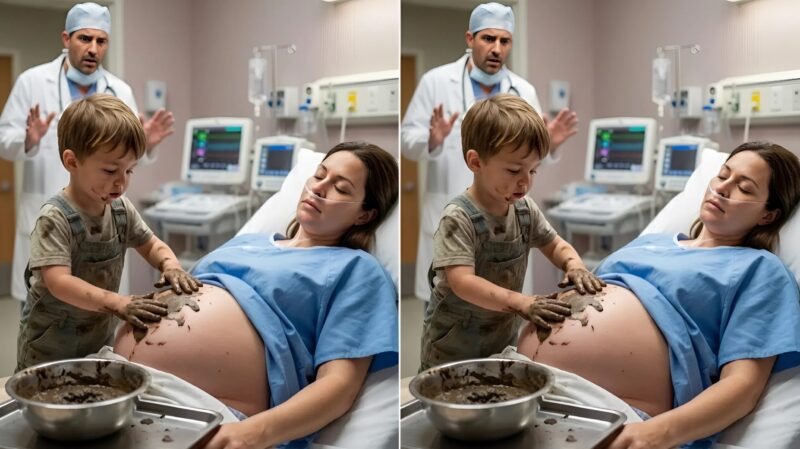
The doctors rushed into the room almost simultaneously. The monitor left no doubt: the readings were changing, the heart rhythm was becoming unstable but alive, and Laura’s breathing was no longer mechanical.
She was showing signs of life. Real, undeniable.
Chaos erupted: machines, commands, rapid movements, and focused faces. Someone called for resuscitation, someone else checked the pupils’ response, and Michael stood aside, unable to move or believe what was happening.
At that moment, a nurse ran into the room and, upon seeing the boy, turned pale.

She hurried over, pulled him aside, and quietly but firmly led him out of the room. Only later did it become clear that he was her grandson — a child who was often at the hospital and had long known Laura’s story.
The boy said that he remembered his grandmother’s words. When he himself fell and got dirty in the soil, she would always say: “It’s nothing, did you know that dirt can sometimes be healing?”
That thought would not leave his mind, and he decided, with childlike sincerity, to help the woman everyone spoke about in whispers.
No one could explain what had happened from a scientific point of view. But the fact remained: at that very moment, when the child touched her belly, Laura returned to life.
