What I Built After the Fire
When I was nineteen, my father decided I no longer belonged in his home.
There was no long conversation, no attempt to understand my choice. Just a line drawn, firm and final. I had decided to attend a trade program in Columbus—something practical, something honest—but to him, it was defiance.
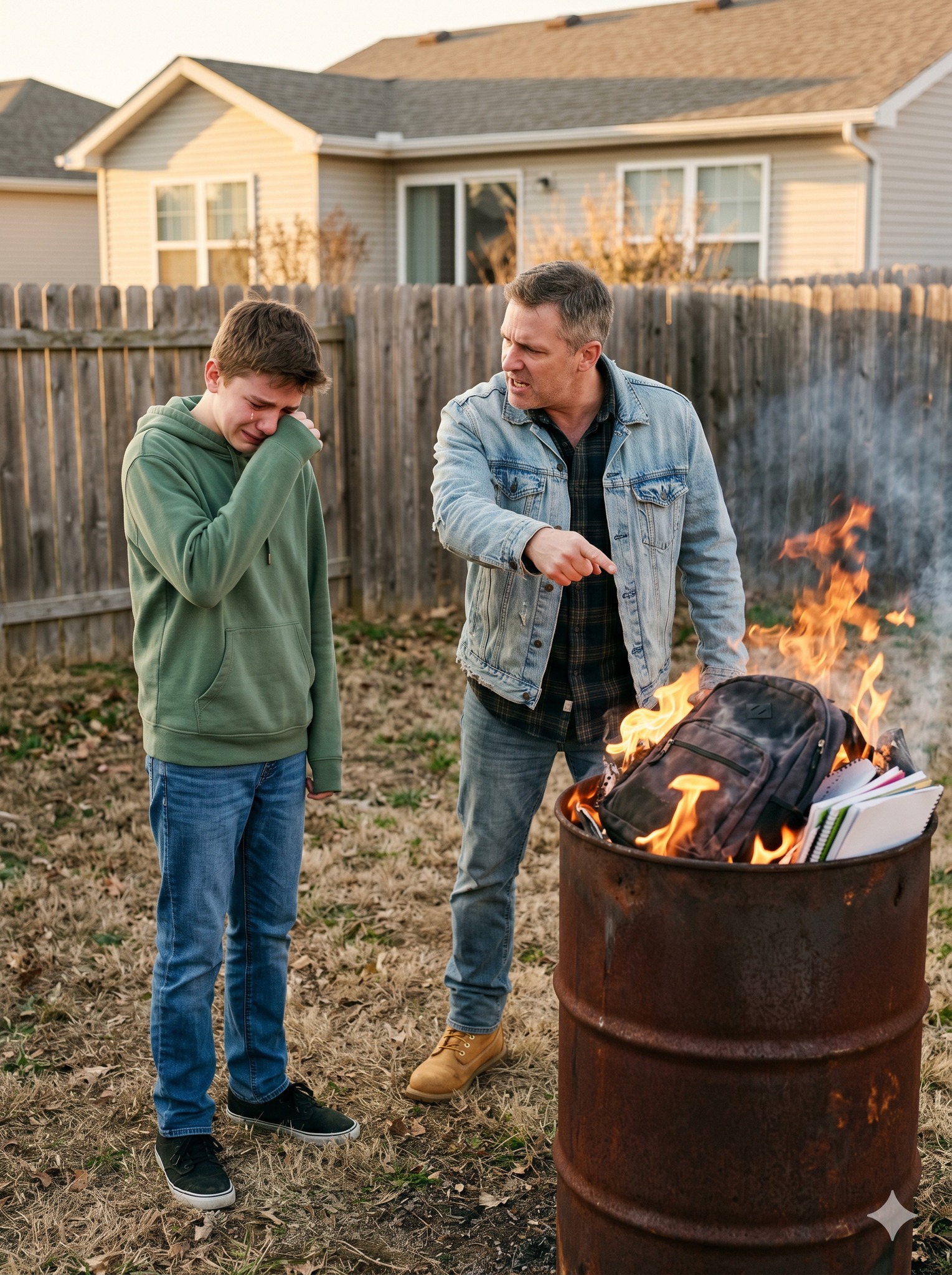
That evening, he dragged my belongings into the backyard. Clothes, work boots, a cheap laptop, and one photograph of my mother I had kept close for years. He placed everything into a metal barrel and set it on fire.
He said it was a lesson.
I didn’t argue. There are moments when words don’t change anything, and speaking only feeds the anger already there. I stood at a distance and watched the fire take what little I had, knowing at least one thing was still intact—my documents, my savings, packed earlier into my friend Nate’s car.
What burned that night wasn’t my future.
It was whatever place I thought I still had in that house.
Nate drove me to Columbus before the night ended. I had forty-three dollars, a backpack, and no clear plan beyond one decision: I would not become what I had just witnessed.
The next few years were not dramatic, just steady and difficult. I slept where I could—friends’ couches, spare rooms, sometimes places that barely counted as shelter. During the day, I took demolition jobs. Hard work, long hours, the kind that leaves your hands raw and your body tired enough to sleep anywhere.
At night, I went to class.
I didn’t approach it as ambition. It was survival. Learn the trade, keep moving, don’t fall behind. I paid attention to the older workers—the way they measured twice before cutting, the way they fixed things other people had written off. There was something honest in that work. You saw the damage, you dealt with it, and when you were done, something stood again.
By twenty-four, I had my license.
Soon after, I started my own company—Hayes Restoration and Build. Not large at first, just small jobs, overlooked properties, the kind people avoided because they looked like too much trouble. But those were the jobs I understood best. Broken things didn’t intimidate me. They made sense.
Over time, the work grew.
Not quickly, not easily, but steadily. Enough to build something stable. Enough to know I had stepped fully into my own life.
Then, years later, I saw a familiar address listed in a tax auction.
My childhood home.
Time had done its quiet work. The place I once knew was now neglected, worn down, the structure itself beginning to give in to years of being left behind. My father had fallen behind on taxes. The house, like everything else, had reached a point where it could no longer hold its place without care.
I went to the auction.
There was no hesitation when the bidding started. I didn’t raise my hand out of anger or to prove something. I did it because I could. Because I had built something that allowed me to stand there and make that decision without asking permission.
When it was done, the house was mine.
I drove there that afternoon. The porch leaned slightly, the paint had faded, the yard was uneven. I stood there for a moment, not with satisfaction, but with a kind of stillness.
I took a picture and mailed it to my father.
Not as a gesture of victory, but as a quiet acknowledgment of how far things had moved.
When he called, his voice carried the same sharp edge I remembered. He wanted answers, explanations, something he could push against. I didn’t match his tone. I didn’t need to.
I reminded him of something simple: power can be used in more than one way.
Then I followed the legal process.
No public scenes. No humiliation. Just paperwork, timelines, and a clear boundary. He left the property the same way many people do when life shifts under them—quietly, with more weight than they expected.
Afterward, I stayed.
Not out of attachment, but because the house needed work. Weeks passed as I repaired what had been neglected—foundation, structure, small details that take time and patience. It wasn’t about reclaiming the past. It was about doing the work properly, the way I had learned.
When it was finished, I sold it.
Fairly. Without squeezing every possible dollar from it.
The money could have gone anywhere. There were plenty of reasons to keep it, to turn it into something visible, something that proved success in a way others could measure.
But I chose differently.
I used it to repair housing for young adults aging out of the foster care system. People starting from nothing, often without anyone to call, without a place that feels like it’s theirs.
It felt… right.
Not dramatic. Not heroic. Just aligned with something I had learned the hard way—that having nothing teaches you what matters when you finally have something to give.
I never forgot that night by the barrel.
But I stopped carrying it as anger.
In the end, the fire didn’t define me. It clarified something.
What I build, how I use what I have, and the way I treat others when I have the upper hand—that’s where the real difference shows.
And that difference is quiet, but it lasts.
