Part 2 My older brother drove up to help me move, but he arrived at my martial arts gym ten minutes early3
PART 2
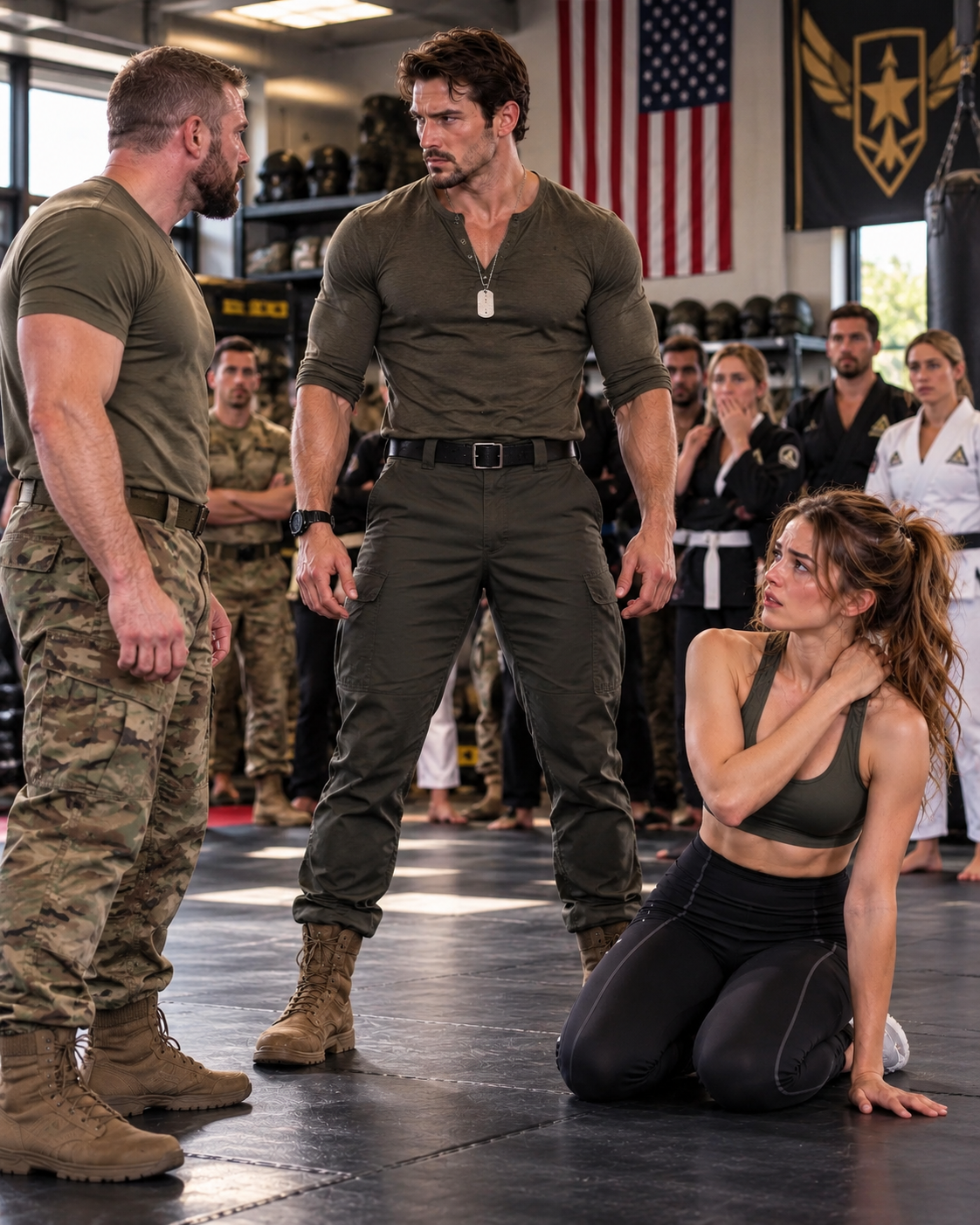
Derek’s hand shot toward Cole’s neck.
Cole moved half a step.
That was all.
There was no dramatic collision, no wild scramble, no sudden display of force. One moment Derek was charging forward with the confidence of a man accustomed to controlling every exchange; the next, his hand had found nothing but air, and Cole was standing slightly to his left.
Derek stopped and turned.
A few people near the wall shifted uneasily.
I was still sitting on the edge of the mat with my knees pulled toward my chest, breathing carefully through a throat that felt scraped raw. Everything around me seemed too bright. The overhead lights. The white lettering on the black wall pads. The silver water bottles lined beside the cubbies.
I watched my brother.
I knew Cole better than anyone in the room.
At least, I had always believed I did.
But there was something different in the way he stood now.
Not aggression.
Not anger.
Attention.
That was somehow more unsettling.
Derek reached again, this time more cautiously.
Cole caught his wrist, redirected it, and let go almost immediately.
Derek frowned.
“You planning to dance all night?”
Cole’s expression remained neutral.
“You asked if I knew how to grapple.”
“So grapple.”
Cole looked toward me.
His eyes rested on my face for barely a second, but something passed between us.
A question.
Are you okay?
I nodded, though I wasn’t sure I was.
Cole turned back.
Derek advanced.
This time, when they made contact, the difference between them became obvious in an unexpected way.
Derek was stronger.
There was no pretending otherwise.
He was heavier by at least forty pounds and trained specifically for this sport. His hands were fast, his balance excellent, his pressure deliberate. Within seconds he had secured a grip behind Cole’s neck and another at his arm.
Someone whispered, “He’s got him.”
But Cole didn’t seem concerned.
He lowered his center of gravity and moved with Derek rather than against him.
Their feet slid over the mat.
Derek attempted to turn him.
Cole stepped through the motion.
Derek changed direction.
Cole changed with him.
It looked less like a fight and more like two people trying to solve the same complicated puzzle at different speeds.
Then Cole disengaged.
He stepped backward.
Derek stared at him.
“What are you doing?”
“Training.”
“You’re running.”
Cole glanced at the timer on the wall.
“Four minutes left.”
A few people exchanged looks.
Derek’s face tightened.
That was when Evan finally came out of the office.
Evan Mercer owned Apex Grappling.
He was forty-two, broad-faced, usually cheerful, and the kind of person who could make a new student feel welcome within thirty seconds. He remembered names. He checked on injuries. He had once spent twenty minutes after class helping me understand a basic escape because he could tell I was embarrassed to ask during the lesson.
That was part of what had made Derek so confusing.
I liked Evan.
Most people did.
And yet Derek had been allowed to behave the way he behaved.
Evan stopped in the doorway.
“What’s going on?”
Nobody answered.
His eyes moved from Cole to Derek, then to me.
The expression on his face changed.
“Sarah?”
I tried to stand.
The room tilted slightly.
One of the women beside me, Maya, touched my elbow.
“Stay down a minute.”
Evan crossed the room quickly.
“What happened?”
Derek answered before I could.
“She got caught in a choke. Went out for a second.”
Evan looked at him.
“After she tapped?”
Derek gave a short laugh.
“Come on. It happened fast.”
“No,” Cole said.
Evan looked toward him.
Cole’s voice was quiet.
“She tapped three times. Then again against his shoulder.”
Derek spread his arms.
“You her lawyer now?”
Cole ignored him.
Evan turned to me.
“Sarah?”
Every face in the gym seemed to be waiting.
My pulse jumped.
That old instinct arrived instantly.
Minimize it.
Smile.
Tell everyone you were fine.
Don’t create trouble.
Don’t become the difficult person in the room.
It was the same instinct I had carried into school, jobs, relationships, family dinners.
I hated disappointing people.
I hated making situations uncomfortable.
For most of my life, I had confused endurance with strength.
Cole had never said so, but I suspected it frustrated him.
I swallowed carefully.
“I tapped.”
My voice sounded strange.
Thin.
I tried again.
“I tapped right away.”
Evan’s jaw tightened.
Derek sighed.
“She panicked. Beginners do that.”
“I’m not a beginner,” I said.
The words surprised me.
Derek looked over.
I had been training for fourteen months.
Blue belt was still far away, but I knew when I had tapped.
And I knew the difference between pressure and punishment.
“I tapped,” I repeated.
Maya spoke next.
“I saw it.”
Another voice came from behind her.
“So did I.”
It belonged to Leo, a college student who usually said almost nothing during class.
Derek looked around the room.
For the first time, he seemed less amused than confused.
Not frightened.
Not humiliated.
Just suddenly aware that the usual version of events was not being accepted automatically.
Evan stood.
“Round’s over.”
Derek stared at him.
“What?”
“You’re done tonight.”
“That’s ridiculous.”
“Go change.”
Derek’s shoulders rose.
For one uncomfortable second, I thought he might argue.
Instead, he looked toward Cole.
“Your brother shows up and suddenly everybody grows a backbone.”
Cole’s expression didn’t change.
“No,” he said. “They already had one.”
The room went quiet again.
Derek looked away.
He walked toward the locker room.
Cole didn’t watch him leave.
That mattered to me.
He didn’t look satisfied.
He didn’t smile.
He simply came over and crouched beside me.
“How’s your breathing?”
“I’m okay.”
“That wasn’t my question.”
I almost laughed.
That was Cole.
He had always been able to make three words sound like an entire conversation.
“It hurts a little.”
“Dizzy?”
“A little.”
“Nauseous?”
“No.”
“Headache?”
“Not really.”
He looked at Maya.
“Did she hit her head?”
“No,” Maya said. “I was watching. She went limp and Derek lowered her down.”
The fact that she said it so calmly made something cold move through me.
Lowered me down.
As if there were something almost careful about the ending of something that should never have happened.
Cole stood.
“We’re getting you checked.”
“I don’t need—”
“We’re getting you checked.”
There was no force in his voice.
Just certainty.
Normally that would have irritated me.
Tonight, it didn’t.
Evan stepped closer.
“I agree.”
I looked at him.
There was guilt on his face.
Not the quick embarrassment of someone whose gym had experienced an awkward incident.
Something older.
Heavier.
“I should’ve dealt with this sooner,” he said.
I didn’t understand.
“With what?”
Evan looked toward the locker room door.
Then back at me.
“Not here.”
Cole’s eyes narrowed slightly.
Evan shook his head.
“Nothing dangerous. I just… Sarah, go get checked. Please. We’ll talk tomorrow.”
I wanted answers.
But the room had begun to feel too small.
Every person in it reminded me that I had been unconscious on the floor less than ten minutes earlier.
Cole helped me gather my things.
He didn’t touch me until I nodded that it was okay.
That small courtesy nearly broke something open inside me.
We left Apex without another word.
Outside, evening had settled across the parking lot.
The sky was soft purple over the strip mall roofs, and the ordinary world continued with irritating normality. Cars passed on the road. Someone was laughing outside the pizza place two doors down. A delivery driver balanced three paper bags against his chest.
Cole unlocked his truck.
“Hospital?”
“Urgent care.”
He considered it.
“If they send you to the hospital, we go.”
“Fine.”
“Not an argument.”
“Cole.”
He looked at me.
I saw it then.
His hands were steady.
His voice was steady.
But his eyes weren’t.
There was fear in them.
My brother had spent years in places where fear, according to our mother, was simply part of the job.
Yet he had been afraid watching me on that mat.
I softened.
“Urgent care first.”
He nodded.
“Okay.”
We climbed into his truck.
For the first five minutes, neither of us spoke.
Cole drove with both hands on the wheel, exactly at the speed limit.
That was another thing about him.
People assumed someone with his background must love adrenaline.
Cole drove like a retired accountant.
At the first red light, I said, “You never told me you grappled.”
“I don’t.”
“You just avoided a black belt for two minutes without letting him touch you.”
“He touched me.”
“You know what I mean.”
Cole looked at the light.
“I’ve trained some.”
“How much is some?”
“Enough.”
I groaned.
“There it is.”
“What?”
“The Cole answer.”
He glanced at me.
“What’s a Cole answer?”
“Technically truthful while somehow revealing absolutely nothing.”
A corner of his mouth moved.
The light changed.
“That’s a useful skill.”
“Annoying skill.”
“Also useful.”
Despite everything, I smiled.
It hurt my throat.
I stopped.
Cole noticed.
His expression changed again.
“You sure you can breathe?”
“Yes.”
We drove another block.
Then he said, “Why didn’t you tell me about him?”
I knew exactly who he meant.
“Derek?”
“Yes.”
“There wasn’t anything to tell.”
Cole looked at me briefly.
“Sarah.”
“I mean it.”
“He’s done things before.”
“Not like tonight.”
“No.”
“But things.”
I stared out the window.
Restaurants and pharmacies passed behind the glass.
“He goes hard.”
“With everybody?”
I hesitated.
“No.”
“With smaller students?”
“Mostly.”
“Women?”
“Sometimes.”
“New people?”
I folded my arms.
“Cole, don’t interrogate me.”
“I’m not.”
“You are.”
His jaw flexed.
Then he nodded.
“You’re right.”
That surprised me enough to make me look at him.
“I’m sorry.”
Cole rarely apologized casually.
When he did, he meant it.
The defensiveness drained out of me.
“I didn’t tell you because I knew what you’d say.”
“What would I say?”
“That if a place makes me uncomfortable, I should leave.”
“Yes.”
“And I didn’t want to leave.”
“Why?”
The answer came faster than I expected.
“Because I always leave.”
Cole said nothing.
So I kept talking.
“I quit soccer because I was bad at it. I transferred out of chemistry because the professor scared me. I left that marketing job instead of telling my manager she was dumping everyone else’s work on me. I stopped seeing Jenna because every time she got upset, I apologized even when I hadn’t done anything.”
Cole glanced at me.
I looked away.
“I joined jujitsu because I wanted to stop being that person.”
“You’re not that person.”
“Yes, I am.”
“No.”
“You don’t get to decide that.”
His hands tightened slightly on the wheel.
“No,” he said. “I guess I don’t.”
We reached urgent care twenty minutes later.
The waiting room smelled like disinfectant and old coffee.
A television mounted near the ceiling played a home renovation show with captions.
Cole filled out paperwork while I sat with a cold pack against my neck.
That was when I noticed the duffel bag.
It sat beside his chair.
Olive green.
Old.
I had seen it before, years ago, during the rare times Cole stayed at Mom’s house between deployments.
“What’s in there?”
He looked down.
“My stuff.”
“For moving me?”
“Mostly.”
“Mostly?”
He sighed.
“You really don’t let things go.”
“I almost got strangled tonight. I’m using it as permission to be nosy.”
That got a quiet laugh.
“Fair.”
The nurse called my name before I could ask again.
The examination was reassuring.
My oxygen level was normal.
There was no sign of serious injury, though the physician told me to monitor swelling, difficulty swallowing, worsening pain, dizziness, or breathing changes and go to the emergency department immediately if anything changed.
Cole listened as if preparing for an exam.
He asked two practical questions.
I rolled my eyes at the second.
The physician smiled.
“Older brother?”
“How’d you guess?”
“He has the look.”
“What look?”
“The one that says he’s going to memorize every instruction I give you.”
Cole seemed almost offended.
“I’m writing them down.”
The doctor laughed.
For the first time all evening, I did too.
When we came outside, it was fully dark.
Cole opened the passenger door for me.
“Food?”
“I’m not hungry.”
“Soup.”
“I’m twenty-six.”
“Congratulations.”
“Cole.”
“Soup.”
I gave up.
We stopped at a quiet diner and ordered chicken soup, grilled cheese, and coffee.
Cole insisted I take the booth seat facing the room.
I noticed because he normally took it himself.
I didn’t say anything.
Halfway through the meal, his phone buzzed.
He glanced at the screen.
Then turned it facedown.
“Who is it?”
“Nobody.”
“Cole answer.”
He sighed.
“Evan.”
I lowered my spoon.
“You gave him your number?”
“He asked before we left.”
“What does he want?”
Cole hesitated.
“He wants to talk tomorrow.”
“To you?”
“To both of us.”
I stared into the soup.
“What did he mean earlier?”
“I don’t know.”
“You have an idea.”
“I have several ideas. Ideas aren’t facts.”
There was something about the way he said it that reminded me of Dad.
Our father had been a newspaper reporter for most of his life.
Facts first.
Assumptions later.
He had said that constantly when we were kids.
Cole must have noticed my expression.
“What?”
“You sounded like Dad.”
The air changed.
It was subtle.
But I felt it.
Cole picked up his coffee.
“Happens sometimes.”
I watched him.
Dad had died nine years earlier from a heart attack at fifty-eight.
Cole had been overseas.
He had missed the funeral.
Not by choice.
But grief did not care about logistics.
For years afterward, Cole barely spoke about him.
“Do you still think about not being there?”
Cole’s eyes remained on his coffee.
“Yes.”
I wished immediately that I hadn’t asked.
Then he surprised me.
“More than I should.”
“There isn’t a should.”
“That sounds like something Mom would say.”
“She’s usually right.”
“Don’t tell her I said that.”
I smiled faintly.
Cole’s phone buzzed again.
This time he ignored it.
We finished eating.
At my apartment, boxes covered almost every surface.
Cole surveyed the living room.
“You packed nothing.”
“I packed books.”
He looked at twelve cardboard boxes labeled BOOKS.
“You own furniture too.”
“Books are emotionally complicated.”
“Books go in boxes.”
“You don’t understand.”
“No. I do. I’m choosing not to participate.”
For the next hour, we packed quietly.
Normal tasks began to settle my nerves.
Tape tearing.
Drawers closing.
The scrape of cardboard across carpet.
Cole was good at moving.
Of course he was.
He packed my kitchen in twenty minutes while I took fifteen deciding whether to keep a chipped blue mug.
At ten thirty, I found him standing beside my bookshelf holding an old framed photograph.
Dad.
Cole.
Me.
I was eleven.
Cole was twenty-two and home on leave.
We were standing at a lake, all three of us sunburned and laughing.
“I forgot you had this,” Cole said.
“Mom gave it to me.”
He wiped dust from the glass.
I watched his face.
“Why did you really come today?”
“To help you move.”
“You could’ve come tomorrow.”
“You said Saturday.”
“I said anytime this weekend.”
Cole put the photograph carefully into a box.
“Sarah.”
“You showed up three hours earlier than we planned.”
He didn’t answer.
Something small clicked into place in my mind.
The duffel bag.
Evan calling him.
The way Cole had gone quiet when I mentioned Dad.
“You weren’t just coming to help me move.”
He looked toward the window.
For several seconds, neither of us spoke.
Then he sat on the arm of the couch.
“No.”
My stomach tightened.
“Why?”
He rubbed his palms together slowly.
“Do you remember Dad’s storage unit?”
“Barely.”
After Dad died, Mom had cleared most of it.
Old newspapers.
Camping equipment.
Boxes from his reporting days.
“Mom called me last week,” Cole said. “She’s finally closing it.”
“I thought she did years ago.”
“She closed the big one. Apparently there was a smaller locker Dad had prepaid for a long time.”
I frowned.
“What was in it?”
“Not much.”
“Cole.”
“Files. Some notebooks. Photographs.”
My heartbeat picked up.
“And?”
He looked at me.
“A letter.”
“For you?”
He shook his head.
“For us.”
I sat opposite him.
“From Dad?”
“It was in his handwriting.”
“Why didn’t Mom tell me?”
“She found it Thursday. She called me first.”
That hurt more than I expected.
“Why?”
Cole looked tired.
“Because there was something in it she thought I should see before you did.”
The room suddenly felt very still.
“What?”
He looked at the half-packed boxes.
Then at the photograph of Dad now lying beneath a folded towel.
“I brought it with me.”
My voice came out almost as a whisper.
“Where is it?”
“In the duffel.”
“Why haven’t you shown me?”
Cole leaned forward.
“Because after I read it, I didn’t know whether Dad actually meant for us to find it.”
“That doesn’t make sense.”
“It will.”
“Then explain it.”
He looked at me for a long moment.
There was an uncertainty in his face I almost never saw.
Not fear.
Not hesitation.
Something closer to shame.
“Dad wrote it after our last fight.”
I knew which fight.
Everyone in our family did.
Three weeks before Dad died, he and Cole had argued in Mom’s kitchen.
I had been seventeen.
I remembered raised voices behind the door.
Dad saying, “You can’t keep disappearing.”
Cole saying, “You have no idea what you’re talking about.”
Then a slammed door.
They never spoke again.
At least, that was what I had always believed.
Cole stood and went to the duffel bag.
He unzipped the side pocket.
Inside was a yellowed envelope.
My name was written on the front.
Not Cole’s.
Mine.
SARAH.
I stared at it.
“You said it was for us.”
“It is.”
“My name is on it.”
“Yes.”
“Did you open it?”
“No.”
“Then how do you know?”
Cole reached into another pocket.
He removed a second envelope.
That one had his name on it.
COLE.
The seal was broken.
“I read mine.”
I looked at the two letters.
For nine years, I had believed the last chapter between my father and my brother was an argument neither of them had been able to repair.
Now Cole stood in my half-empty apartment holding proof that the story had continued after I stopped looking.
“What did Dad say?”
Cole sat down again.
His eyes lowered to the envelope in his hands.
“He apologized.”
I swallowed.
“For the fight?”
“For more than that.”
Outside, someone closed a car door.
A dog barked somewhere across the complex.
Cole turned the envelope over slowly.
“Dad knew something about me that I never told you.”
My breath caught.
“What?”
He looked up.
And for the first time that night, my brother—the man who had walked into a gym full of strangers without blinking—seemed genuinely uncertain about what would happen next.
“He knew why I left the Army.”
-END OF PART 2 – PLEASE LIKE THE POST AND GO TO THE COMMENTS SECTION TO READ THE NEXT PART
