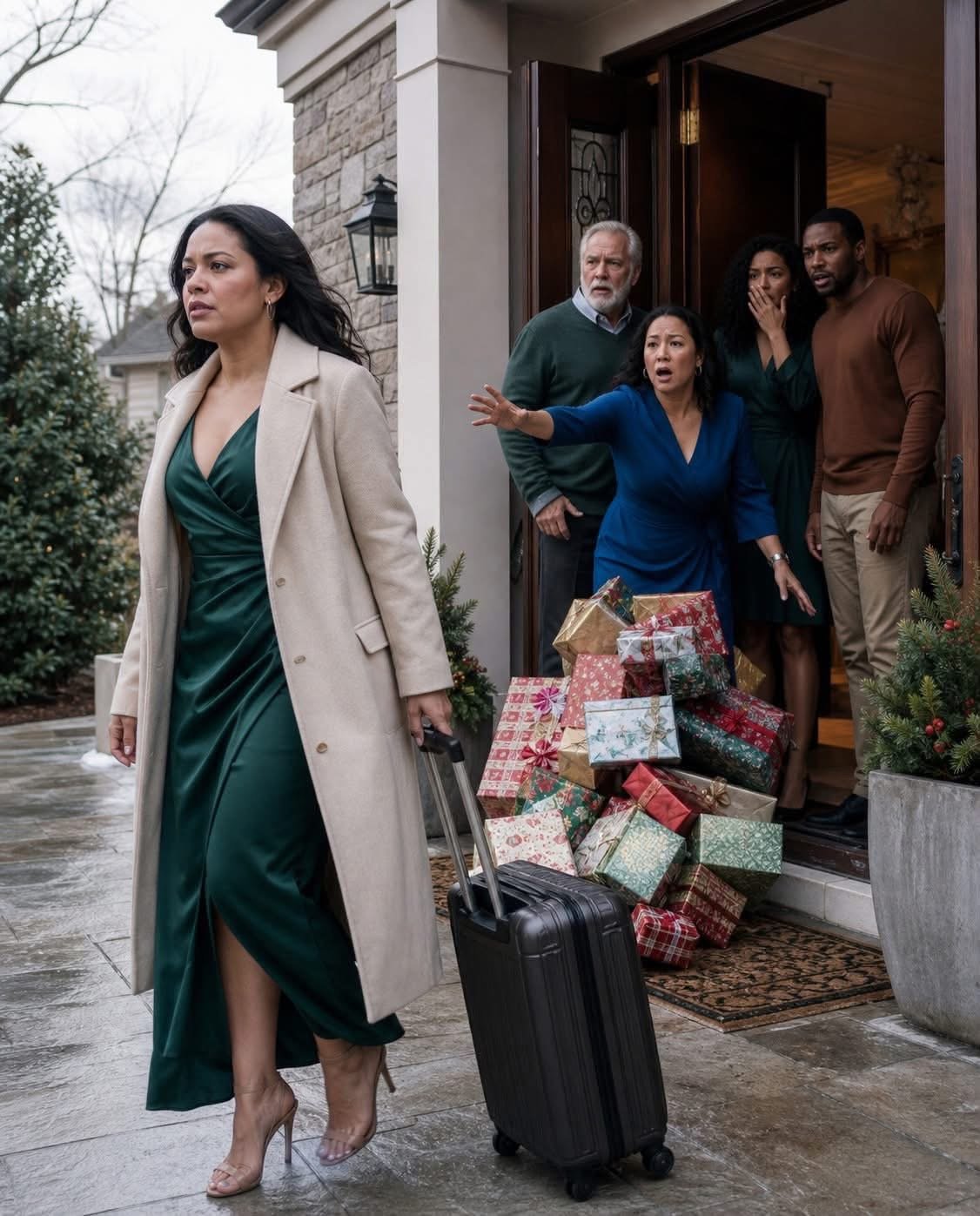
The white courier envelope from Cho Law Offices sat on the granite island next to the silver gravy boat. The gravy boat was a genuine Gorham piece, valued at eighty dollars, which my mother had left at my house after Thanksgiving so I could polish the tarnish off the spout before the next family gathering.
My nine-year-old daughter, Emma, stood by the toaster, carefully folding paper napkins into neat triangles. She adjusted the hem of her green cardigan, twisting the knitted cotton around her small index finger.
“Is Grandma Helen going to like the potato casserole, Mom?” Emma whispered.
“Everyone likes warm potatoes, sweetie,” I said, keeping my voice low and level.
I slipped the thick, white Tyvek envelope into the side pocket of my leather tote bag and zipped it shut. The return address was Daniel Cho, Attorney at Law, Route Four. Emma did not notice the movement; she was too busy lining up the corners of her third paper napkin.
“Should I put the napkins in the basket now?” Emma asked.
“Put them right on top of the container,” I said, fitting the blue plastic lid over the steaming hash browns.
The scent of damp pine needles drifted from the back porch where the holiday wreath hung against the glass. I glanced at my wristwatch, a silver Seiko I had owned for ten years, and adjusted the leather strap by one notch to keep my fingers busy. We needed to leave Maple Avenue by five if we wanted to beat the holiday traffic heading toward Elm Street.
The grandfather clock in my parents’ hallway ticked with a heavy, metallic rhythm that always seemed to slow down the closer we got to January. The living room smelled of artificial pine spray and the sharp, vinegar scent of my mother’s lemon furniture polish.
My mother, Helen, stood by the grand brick fireplace, adjusting a double strand of faux pearls that sat against her high-collared red blouse. Below her, a dozen glittering gift bags were arranged in a perfect semi-circle under the artificial tree.
“You brought the casserole in that plastic dish, Julia?” Helen asked, her voice carrying that familiar, sharp edge. “Couldn’t you find the ceramic server I gave you three years ago?”
“The plastic lid keeps the steam in, Mom,” I said, setting the heavy container on the buffet table next to a tray of dried fruit.
“I suppose presentation doesn’t matter much on Maple Avenue,” Helen said, her fingers sliding over her pearls. “But some of us still prefer to keep up appearances for the holidays.”
My father, Arthur, sat in his brown leather recliner by the television, his thumb resting flat against the rubber buttons of the remote control. He did not look up when we entered, his eyes fixed on a muted college basketball game.
“Arthur, did you hear me?” Helen asked, turning her shoulder toward him. “I said Julia is here.”
Arthur gave a short, gravelly grunt, his thumb pressing the volume button up two notches before lowering it again. “Traffic on Route Four must have been a mess,” he said to the screen.
“It wasn’t bad, Dad,” I said.
Brent, my forty-one-year-old brother, walked out of the kitchen holding a long-neck beer bottle. He wore a brand-new wool sweater with the price tag still tucked under the collar, and he gave me a defensive, mocking chuckle as he leaned against the doorframe.
“Look who decided to join the taxpayers,” Brent said, scraping a speck of dirt from his thumbnail with the edge of his beer cap. “Did you bring that low-budget holiday spirit with you, Jules?”
“We brought dinner, Brent,” I said, keeping my voice at the steady, quiet pitch I had practiced in the car.
My daughter Emma crept into the room behind me, her long brown hair falling over her face as she reached for my hand. My son, Noah, who was only six, stood near the hallway, his boots still wet from the slush outside.
“Go sit by your cousin Tyler, kids,” Helen said, pointing a manicured finger toward the corner where Brent’s twelve-year-old son was playing a game on his phone. “But don’t touch his tablet. That was a very expensive early gift from his father.”
Emma twisted the hem of her cardigan, her small body shrinking back against my coat.
“They can sit with me on the sofa,” I said.
“Oh, don’t be so dramatic, Julia,” Helen said, her voice rising as she straightened a gold bow on one of the larger gift bags. “Shouldn’t children learn to socialize without clinging to their mothers’ skirts?”
I reached down and adjusted my wristwatch again, pulling the leather strap tight against my wrist until the metal buckle pinched.
Dinner was eaten in silence, save for the sound of Arthur’s fork scraping against his plate and the hum of the television commercials. The silver gravy boat sat unused at the end of the table, a polished relic that nobody wanted to pass.
By eight o’clock, Helen had gathered everyone around the tree for the presentation of the gifts. The grandfather clock chimed the hour, its heavy brass weights swinging behind the glass door.
“Now, let’s see who has been especially helpful this year,” Helen said, her voice carrying a bright, theatrical lilt.
She reached under the green boughs and pulled out a large, glittering blue bag with silver tissue paper poking out of the top.
“This one is for Tyler,” Helen said, handing the bag to Brent’s son. “For being such a wonderful athlete and making the traveling team.”
Tyler tore into the paper, pulling out a signed baseball jersey. “Awesome,” he muttered, not looking up from his lap.
“And this is for Brent,” Helen continued, lifting a heavy rectangular box wrapped in gold foil. “To help with those new tools he needed for the shop.”
Brent let out that brief, mocking chuckle and set the box on his knee. “Thanks, Mom. Some people actually understand what it takes to run a business these days.” He looked over at me, his fingers tapping the cardboard.
“And of course, something beautiful for Arthur,” Helen said, passing a small, velvet-lined box to my father, who grunted and set it on the side table without opening it.
Emma sat perfectly still on the edge of the sofa, her hands tucked under her thighs. Noah was looking at the remaining bags under the tree, his eyes wide.
Helen reached down and pulled the very last bag from beneath the lowest branch. It was a small, white paper bag with Tyler’s name written on the tag in green marker.
“Who will receive the final gift under the tree?” Helen murmured, looking directly at Emma with a thin smile. “I believe this one also belongs to Tyler, for his excellent grades this term.”
“That’s three for me,” Tyler said, sliding the white bag toward his pile. He looked at Emma, his expression blank. “Didn’t you guys get anything?”
Emma pulled her long brown hair forward, completely veiling her face as her shoulders began to rise and fall in silent, rhythmic hitches.
“Dad,” I said, my voice remaining low. “Are we finished here?”
Arthur did not look up from the television screen. He pressed the channel button on the remote, the screen flashing from a car commercial to a news broadcast. “The weather is supposed to turn cold tonight,” he muttered.
“Mom,” I said, turning to Helen. “You told me we were keeping things small this year.”
“We did keep them small, Julia,” Helen said, her fingers rising to touch her faux pearls. “But surely you don’t expect us to ignore the children who actually make an effort to be part of this family?”
“Emma made you three drawings last week,” I said.
“Drawings don’t pay the heating bill, Julia,” Brent said, laughing as he leaned back against the cushions. “Maybe if you spent less time hiding out in your little kitchen on Maple Avenue, your kids would get a turn.”
I looked at my brother, then at my mother, who was busy smoothing the crumpled wrapping paper on the floor. Neither of them looked back at me with anything resembling shame.
“Noah, Emma, get your coats,” I said.
“Oh, don’t make a scene, Julia,” Helen said, her voice dropping into a sharp, warning tone. “It’s New Year’s Eve. Don’t ruin the evening because you’re envious of your brother’s success.”
I did not answer her. I reached down, took Emma by her trembling shoulders, and guided her toward the hallway.
The air outside was bitter, carrying the scent of rotting leaves and wet asphalt. The streetlights on Elm Street cast long, yellow shadows across the gravel driveway where our cars were parked.
I carried the glass casserole dish in one hand, the glass now cold and sweating against my palm. Emma walked beside me, her head tucked down into the collar of her coat, her quiet whispers muffled by the wind.
“Mom, did we do something wrong?” Emma whispered, her voice cracking as we reached the passenger door.
“No, sweetie,” I said, opening the door and helping her slide onto the cold fabric of the seat. “You did absolutely nothing wrong. You are perfect.”
Noah scrambled into the back seat behind her, pulling his knees up to his chest.
I set the cold casserole on the floorboard of the front seat. The white Tyvek envelope from Daniel Cho was still tucked safely inside my tote bag, a heavy square of paper that they had no idea existed.
I got into the driver’s seat and turned the key. The heater groaned, blowing cold air into the cabin before the engine could warm.
“Are we going home, Mom?” Noah asked from the back.
“We are going home,” I said, looking at the rearview mirror. “And we are going to make midnight pancakes. With real syrup and paper crowns.”
“Can we stay up until midnight?” Emma asked, her voice still shaky but lifting slightly.
“Yes,” I said. “As late as you want.”
I shifted the car into reverse and looked up at the house. The large bay window of the living room was brightly lit, showing the silhouette of my mother still standing by the tree, her hand resting on her pearls. Brent’s truck sat in the driveway beside us, its chrome wheels catching the dull yellow of the streetlamp.
They would find out what was in the white envelope soon enough.
I backed out of the driveway, the tires crunching over the gravel, and did not look back again as the house slid into the dark.
The kitchen smelled of warm butter and vanilla, a deliberate shield against the cold drive home from Elm Street.
Emma and Noah sat at the round oak table, wrapped together in a faded green fleece blanket, their eyes fixed on the small television on the counter where a cartoon mouse was silently escaping a trap.
I slid the metal spatula under a bubbling circle of batter and flipped it, watching the golden steam rise into the bright, quiet room.
“Mom, did we do something wrong?” Emma asked.
She was twisting the hem of her red cardigan around her finger, her voice barely louder than the hum of the refrigerator.
“No, sweetheart,” I said, putting two warm pancakes on a blue plate and sliding them onto the table between them. “You did everything perfectly. Tonight was just about adults being foolish.”
Noah reached for the syrup, his small fingers sticky, his face still pale from the long, quiet car ride.
“Why didn’t Tyler have to share the blue box?” he asked, looking at his sister.
“Because some people have a hard time remembering how to be kind,” I said, setting the spatula on the stove grid with a soft clink. “But we have everything we need right here.”
I watched them eat, their small shoulders finally relaxing under the weight of the blanket, until their eyelids grew heavy enough that they let me lead them upstairs to their beds.
Once their bedroom doors were closed and the hallway was silent, the quiet of the house felt less like a shield and more like an empty space waiting to be filled.
I sat at the kitchen table, the yellow light from the stove hood casting long shadows across the linoleum, and pulled my laptop toward me.
My fingers hovered over the keys for three seconds before I logged into the online portal for the children’s educational trust account, the one my grandfather had set up before he died.
The main screen loaded, showing the steady balance I expected, but when I clicked the tab for the secondary savings ledger, the numbers did not align with my mental math.
A withdrawal of four thousand two hundred dollars had been cleared on the twelfth of December.
I stared at the transaction line, checking the routing number to ensure it was not a scheduled tax payment I had forgotten.
The funds had been moved via an in-person counter withdrawal at the local branch on Broad Street, a physical transaction requiring a signed paper slip.
Only three people had legal access to this portal, and two of them did not even own a computer.
I tried to pull up the digital image of the withdrawal slip, but the screen displayed a grey box with a message instructing the account holder to request paper copies directly from the branch manager.
The room felt suddenly colder, the faint smell of pancake syrup turning sickly sweet in the warm air.
I searched my kitchen desk for the physical monthly statements that usually arrived by mail from that Broad Street branch, but the folder for the last quarter was empty.
Someone had intercepted them, or they had been redirected to a different address entirely.
I did not call my mother, and I did not text Brent.
Instead, I printed the ledger page, folded the white paper into three neat sections, and slipped it into my purse next to the thick courier envelope Daniel Cho had sent me the week before.
By nine the next morning, the glass doors of the strip mall office on Route Four were reflecting the grey winter sky.
The receptionist at Cho and Associates pointed to a leather chair in the lobby, her smile professional and tight.
“Mr. Cho is in a brief phone conference, Julia, but he said to have you wait right here,” she said.
I sat down, keeping my purse on my lap with both hands flat across the top of the leather strap.
A man in a heavy work coat entered the lobby, shaking damp salt from his boots onto the rug, and asked the receptionist for a copy of a property deed.
My father had always told me that family business belonged behind closed doors, but he had spent thirty years looking at a television remote control while my mother ran the house.
“Julia,” a voice said.
Daniel Cho stood in the doorway of his office, his silver pen tapping twice against a yellow legal pad.
His tie was perfectly straight, and his eyes had the quiet, unblinking focus of a man who spent his life reading the small print that other people ignored.
“Come on back,” he said, gesturing with the pen toward the inner office.
The room smelled of old paper and wood polish, dominated by a large mahogany desk that held three neat stacks of folders and a single cup of black coffee.
I sat in the green leather chair opposite him and placed my printed bank page on the blotter between us.
“This went out on the twelfth,” I said.
Daniel picked up the paper, his eyes scanning the transaction line before he reached into his desk drawer for a thick, blue cardstock folder.
He pulled out the original trust agreement from five years ago, its pages bound with heavy brass eyelets.
“Your grandfather’s terms were very specific,” Daniel said, turning to the third page and tracing a line of text with the tip of his silver pen. “You are the sole trustee with withdrawal authority for the educational accounts. Arthur and Helen are listed as beneficiaries of the residency trust, but they have no administrative access to these funds.”
“Then how did a teller hand over four thousand two hundred dollars in cash at the Broad Street branch?” I asked.
Daniel tapped the paper again, his expression remaining perfectly flat.
“They shouldn’t have,” he said. “Unless a signature was presented that matched the card on file.”
The grandfather clock in the corner of his office ticked once, a heavy, metallic sound that seemed to mark the exact moment my doubts turned into something concrete.
“I want a full audit,” I said. “Every transaction, every withdrawal slip, going back eighteen months.”
Daniel looked at me for a long moment, then reached for a clean authorization form from his side drawer and slid it across the desk.
“If we find discrepancies, Julia, this goes beyond a family dispute,” he said.
I picked up the pen he offered and signed the paper with a steady hand.
The radiator in the local history room of the Oakhaven Public Library hissed like a dying kettle. My father sat at the end of the long oak table, a stack of back-issue Ohio Conservationist magazines piled near his elbow. He did not look up when my boots squeaked on the worn green linoleum.
“They moved the high school basketball game to Thursday,” he said, his voice barely above a grunt. “Can’t ever keep the schedule straight in this town.”
I sat down opposite him. The wooden chair scraping against the floor made a sharp, dry sound that brought a quick frown from the librarian at the desk. I laid a copy of the quarterly water bill between us on the polished wood.
“The city sent a shut-off notice for Elm Street, Dad,” I said. “It was in the mail yesterday. It says three months are past due.”
My father shifted his weight, his heavy winter coat rustling against the high back of the chair. He did not look at the blue paper. He reached into his shirt pocket and pulled out his reading glasses, slowly folding and unfolding the plastic frames.
“Your brother handles the bills now,” he said. He kept his eyes on the cover of a magazine featuring a white-tailed deer in a snowy woods. “Brent took over the checkbook after my knee surgery in November. Your mother wanted it that way.”
“Brent hasn’t paid the water or the gas since October,” I said. “The total is nine hundred and eighty dollars. Did you give him the money from the pension account?”
He looked past my shoulder toward the high, narrow window. The gray afternoon light made his thin hair look like spun glass. He cleared his throat, a wet, rattling sound that ended in another short grunt.
“Your brother and his family need stability,” he said.
I adjusted my wristwatch, sliding the leather strap back until the metal buckle pinched my skin. The silence between us stretched until the radiator gave another long, metallic shudder.
“He lives in your basement for free, Dad,” I said. “He doesn’t pay rent, and now he isn’t paying the utilities. The money is coming out of the house trust.”
My father stood up, his knees popping in the quiet room. He gathered his magazines with slow, deliberate movements, keeping his eyes on the glossy covers.
“Ask your mother,” he said. “I don’t have anything to do with the checkbook anymore.”
He walked toward the return bin without looking back, his heavy boots thudding against the floor.
I left the library through the side exit and drove toward Elm Street.
The scent of wet asphalt and soapy water hit me before I even opened my car door.
Brent was standing in the driveway of the family home, holding a green garden hose with a brass nozzle. His new black pickup truck, a heavy quad-cab model with chrome running boards, sat dripping on the concrete. The soap bubbles on the hood were already freezing into thin, white skins in the December air.
“Nice truck,” I said, stepping over a small stream of dirty foam.
Brent turned the nozzle, cutting off the water with a sharp click. He let out a short, defensive chuckle and wiped his wet hands on his jeans.
“Used got too expensive,” he said. “Had to buy new. It makes sense if you look at the financing.”
“I looked at the bank statements, Brent,” I said. “There are four separate withdrawals from the local branch that don’t have matching receipts. They total over four thousand dollars.”
He examined his thumb, using his index fingernail to scrape at a speck of dried wax near the cuticle. He did not look up.
“The roof had a leak over the back porch,” he said. “I had to buy shingles and hire a couple of guys from the lumber yard to help me clear the gutters. Ask Mom.”
“The trust ledger doesn’t show any receipts from a lumber yard,” I said. “And the roof looks exactly the same as it did last summer.”
Brent chuckled again, a dry sound that didn’t reach his eyes. He tossed the green hose onto the wet grass.
“You don’t live here, Julia,” he said. “You don’t see what needs doing. Mind your own business.”
He climbed into the cab of the truck and shut the door with a solid, expensive thud.
I backed my car down the driveway and pulled over to the curb three houses down, beneath the bare branches of a dying maple tree.
The heater in my sedan hummed, blowing dry, dusty air against my ankles. I reached into the passenger footwell and pulled my grandfather’s old black vinyl ledger out of my canvas bag. The cover was cracked at the corners, smelling of old paper and the cellar where he used to keep his tax records.
I opened it to the page marked October. My grandfather had kept every utility payment, every roof repair, and every dollar of property tax recorded in his small, precise handwriting until his death six years ago. Beside his neat columns, I laid the printouts of the digital bank statements I had taken from my computer the night before.
On October twelfth, the digital statement showed a withdrawal of one thousand two hundred dollars.
In the ledger, there was only a blank line where the monthly gas bill should have been entered.
On November third, another withdrawal of eight hundred dollars.
I turned the pages back to the spring. There were six separate entries for cash withdrawals, all marked as emergency repairs, but the house on Elm Street still had the same cracked kitchen linoleum and the same dripping faucet in the downstairs bathroom.
The numbers did not match by several thousand dollars.
I shut the ledger and rested my forehead against my hands for a moment, listening to the steady click of the hazards blinking on my dashboard.
The office of Daniel Cho on Route Four was located in the strip mall behind the dry cleaner.
Inside, the lobby smelled of lemon polish and carpet cleaner.
Daniel sat behind a walnut desk that was completely clear except for a yellow legal pad and a silver ballpoint pen. He tapped the pen twice against the yellow paper before sliding a stapled document across the desk toward me.
“This is the certified copy from five years ago,” Daniel said. His voice was flat, professional, and entirely devoid of the tension that had been building in my chest all afternoon. “Your parents signed it in this room. Both of them.”
I turned to the third page. My mother’s signature was there, her letters large and looping, written with the heavy black felt-pen she always preferred. Beneath it was my father’s small scrawl.
