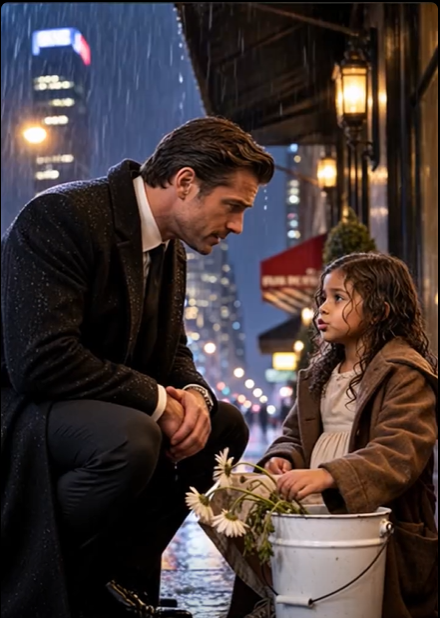
The little girl was shivering outside my restaurant in the pouring rain, and when she told me why nobody would let her inside, I felt something inside my chest break for the first time in fifteen years.
“I’m too poor, sir.”
Four words.
Four words spoken by a child who couldn’t have been more than eight years old.
And somehow, those four words managed to wound me more deeply than any bullet, betrayal, or threat I had survived while building my empire.
My name is Nathaniel Whitfield.
In Nashville, people called me Mr. Whitfield. My employees called me sir. My enemies generally avoided saying my name altogether.
Only a handful of people called me Nate.
And almost everyone who had once spoken that name with genuine affection had disappeared from my life.
I was forty-two years old, controlled properties across Tennessee, and owned enough legitimate businesses to appear on magazine covers without anyone asking too many questions.
The businesses people didn’t know about were considerably more profitable.
I had spent fifteen years building an organization that operated through restaurants, nightclubs, transportation companies, warehouses, and agreements made behind closed doors.
People called it an empire.
Others called it a crime family.
I rarely bothered correcting either description.
Power had become my language. Money had become my protection. Fear had become the easiest way to make sure nobody ever disappointed me twice.
But that Thursday evening, standing beneath the brass awning of Whitfield House, my flagship restaurant, none of those things mattered.
Because a little girl was sitting on the wet sidewalk, trying desperately to protect a bucket of dying daisies.
The rain had soaked her oversized brown coat until it hung like a heavy blanket around her narrow shoulders.
Her sneakers were torn near the toes. Water leaked through their seams whenever she moved.
Her dark curls were plastered against her cheeks, and both hands were wrapped around a plastic bucket that might once have been bright yellow.
Inside were perhaps two dozen flowers.
Most were bent.
Several had already lost their petals.
Yet she guarded them as though they were diamonds.
I noticed her while my security chief, Marcus Hale, was bringing the car around.
“Boss?” Marcus called from beneath his umbrella. “We’re ready.”
I didn’t answer.
The girl had just lifted one wilted daisy toward a passing couple.
The woman glanced at the flower, then at the child’s soaked clothing.
“No, thank you,” she said sharply.
Her husband steered her away.
The girl lowered the flower and whispered something I couldn’t hear.
Then she tried to straighten its damaged stem.
I walked toward her.
“What’s your name?”
She startled so violently that I stopped several feet away.
For a moment, her eyes darted toward the restaurant entrance, as though she expected someone to chase her away again.
“Maya,” she whispered.
“Hello, Maya. I’m Nathaniel.”
She studied my tailored charcoal suit, expensive watch, and polished shoes.
Then she held out a daisy.
“Would you like to buy a flower, sir?”
“How much?”
“Two dollars.”
I looked at the flower.
Its white petals hung limply around a yellow center.
“Only two?”
She nodded.
“But if you want three, I can give you a discount.”
Despite myself, I smiled.
“What kind of discount?”
“Five dollars for three.”
“That’s a good business strategy.”
Her expression brightened slightly.
“My mom taught me.”
Something about the pride in her voice unsettled me.
“Where is your mother?”
“At home.”
“Does she know you’re here?”
Maya’s eyes dropped.
I already knew the answer.
“She thinks I’m downstairs with Mrs. Ellis,” she admitted. “Mrs. Ellis fell asleep. I thought I could sell some flowers before it got dark.”
I glanced at the deserted sidewalk.
“How long have you been sitting here?”
She hesitated.
“Since before the rain.”
My jaw tightened.
That meant hours.
I looked toward the restaurant’s enormous windows. Inside, waiters moved between candlelit tables carrying expensive steaks, imported wine, and desserts decorated with gold leaf.
One bottle on the wine list cost more than many Nashville families earned in a month.
And outside those same windows, a hungry child was trying to sell dying flowers for two dollars.
“Why didn’t you go inside to get warm?” I asked.
Maya swallowed.
“They wouldn’t let me.”
“Who?”
“The man by the door.”
“What did he say?”
She pulled her coat more tightly around herself.
“He said people like me don’t belong in places like that.”
I felt my expression change.
Maya noticed.
“He wasn’t being mean,” she added quickly. “I think he was just telling the truth.”
Then came the words that would haunt me long after that evening.
“I’m too poor.”
For one terrible second, I wasn’t standing outside Whitfield House anymore.
I was six years old again, sitting beside my mother outside a diner in Memphis.
I remembered the smell of frying bacon drifting through the open door.
I remembered watching a family share pancakes while my stomach twisted with hunger.
My mother had counted the coins in her purse three times.
Then she had smiled at me.
“We’ll eat later, sweetheart.”
I had believed her because I needed to.
Later, I learned she had skipped dinner so I could have a sandwich.
I learned that hunger wasn’t always the worst part of being poor.
Sometimes it was the way people looked at you.
Sometimes it was being made to feel invisible.
And sometimes it was knowing there were warm rooms filled with food, but none of those rooms had a place for you.
I crouched beside Maya.
The wet pavement soaked through my trousers.
“Listen to me,” I said. “Being poor doesn’t mean you don’t belong somewhere.”
She looked unconvinced.
“That’s not what the man said.”
“Then the man was wrong.”
“But he works here.”
“I know.”
“Do you work here too?”
I glanced up at the glowing gold letters above the entrance.
WHITFIELD HOUSE.
“In a manner of speaking.”
Maya followed my gaze.
Then her eyes widened.
“You’re the boss?”
“Yes.”
She immediately tried to stand.
“I’m sorry, sir. I wasn’t trying to cause trouble.”
She lifted her bucket, and three flowers fell onto the pavement.
I caught the bucket before it tipped.
“You’re not in trouble.”
“I can leave.”
“You don’t have to leave.”
“I promise I wasn’t begging.”
Her voice cracked on the last word.
That did it.
I had heard grown men beg for things they didn’t deserve. I had watched powerful people lie, threaten, and manipulate without the slightest embarrassment.
But this child was apologizing for being hungry.
I removed my cashmere overcoat.
Maya watched nervously as I draped it around her shoulders.
It swallowed her almost completely.
“Sir, that’s too expensive.”
“You’re cold.”
“But I’ll get it dirty.”
“It’s a coat, Maya.”
She touched the soft material carefully.
“My mom says we should take care of things that aren’t ours.”
“Your mother sounds wise.”
“She is.”
Then her stomach growled.
Loudly.
Maya pressed both hands against it.
Her cheeks turned red.
“Sorry.”
“Have you eaten dinner?”
She shook her head.
“Lunch?”
Another shake.
“Breakfast?”
“A piece of toast.”
I looked away for a moment because I didn’t trust my own expression.
At the restaurant entrance, Marcus was watching.
He had worked for me for eleven years and had seen me respond to threats that would have terrified ordinary men.
But I suspected he’d never seen me look the way I did now.
I reached toward Maya.
“Come with me.”
She stared at my hand.
“Where?”
“Inside.”
Her eyes flickered toward the restaurant.
“But they said—”
“I know what they said.”
I waited.
“Tonight, Maya, this restaurant is yours.”
She didn’t move immediately.
Instead, she studied my face with the wary concentration of someone much older.
“Will I have to pay?”
“No.”
“For the food?”
“No.”
“For sitting down?”
I felt something painful twist beneath my ribs.
“Especially not for sitting down.”
She considered that for several seconds.
Then her small fingers slipped into mine.
Her grip was astonishingly tight.
Together, we approached the entrance.
The doorman straightened when he saw me.
“Good evening, Mr. Whitfield.”
I recognized him immediately.
Cole Benton.
Thirty-six years old. Recently promoted to front-of-house manager. Efficient, polished, and extremely proud of maintaining the restaurant’s exclusive reputation.
His gaze moved to Maya.
Then to the muddy water dripping from her sneakers.
His smile faltered.
“Sir, I wasn’t aware—”
“Open the door, Cole.”
“Of course.”
He stepped aside.
Warm air washed over us.
A piano was playing somewhere near the bar.
The dining room glowed beneath crystal chandeliers, every table arranged with white linen, fresh flowers, and polished silver.
I felt Maya stop just inside the threshold.
She looked around with open astonishment.
“It’s beautiful,” she whispered.
“Come on.”
She took one careful step.
Then another.
A thin trail of rainwater followed her across the marble floor.
Conversation began fading around us.
I knew what the customers saw.
A man whose name appeared in newspapers and business magazines.
A man rumored to have ruined competitors with a single telephone call.
A man accompanied by a soaked little girl carrying a bucket of flowers that belonged in the garbage.
The contrast was impossible to ignore.
At a nearby table, a woman in pearls lowered her wineglass.
Two businessmen stopped talking.
One waiter nearly dropped a tray.
Cole hurried after us.
“Mr. Whitfield, perhaps we could arrange something in the service area.”
I stopped.
“Why?”
He blinked.
“Pardon?”
“Why the service area?”
Cole glanced toward our guests.
“Well, sir, naturally, the child may be more comfortable somewhere private.”
I looked down at Maya.
She was staring at the floor.
“Are you uncomfortable, Maya?”
She hesitated.
“I’m trying not to make a mess.”
I turned back to Cole.
“Get her a towel.”
“Immediately.”
“And a proper chair.”
“Yes, sir.”
“At the best table in the restaurant.”
His expression stiffened.
“Sir, the best table is reserved for—”
“For whom?”
He stopped.
I waited.
“Who could possibly be more important than a hungry child?”
Cole’s face drained.
“Nobody, sir.”
“Then make the arrangements.”
Within minutes, Maya was sitting beside the tall windows overlooking downtown Nashville.
A server brought warm towels.
Another brought hot chocolate.
My executive chef, Anthony Russo, emerged from the kitchen personally.
Anthony had worked with me since the restaurant opened.
He was a broad-shouldered Italian American with silver hair and hands that could transform ordinary ingredients into meals people remembered for years.
He stared at Maya.
Then at me.
“What can I make for our guest?”
Maya looked frightened by the question.
“Anything is okay.”
Anthony smiled gently.
“Do you like chicken?”
She nodded.
“Potatoes?”
Another nod.
“And warm bread?”
Her eyes widened.
“With butter?”
“With as much butter as you want.”
For the first time that evening, Maya laughed.
It was a tiny sound.
But it cut through the dining room more powerfully than a gunshot.
Anthony winked at me before returning to the kitchen.
I sat across from her.
“You don’t have to hurry,” I said.
She was already wrapping both hands around her hot chocolate.
“Okay.”
A moment passed.
Then she looked at my suit.
“Do you eat here every night?”
“Not every night.”
“Why not?”
“Usually I’m busy.”
“Doing what?”
I nearly laughed.
Nobody had asked me that question so innocently in years.
“Working.”
“Must be important work.”
“Some people think so.”
She nodded solemnly.
“My mom works a lot too.”
“What does she do?”
“She cleans offices. And sometimes she helps at a bakery.”
“Two jobs?”
Maya shrugged.
“She’s trying to save enough money.”
“For what?”
The child stared into her cup.
Then she whispered, “So we don’t have to move again.”
I leaned forward.
“What do you mean?”
Before she could answer, Anthony returned with her dinner.
The smell of roasted chicken filled the air.
Maya stared at the plate as though she couldn’t believe it was real.
“All this is for me?”
“Every bite,” Anthony said.
She picked up her fork.
Then stopped.
“Can I take some home?”
My throat tightened.
“Of course.”
“For my mom?”
“Of course.”
“She says she’s not hungry when there’s only enough for one person.”
I went completely still.
Because I remembered those exact words.
Not from Maya.
From my own mother.
I had heard them outside a diner in Memphis thirty-six years earlier.
I had built an empire because I never wanted to hear them again.
And somehow I had created a world where another child was hearing them every night.
Maya began eating.
Slowly at first.
Then with the helpless urgency of someone who had been hungry much longer than she wanted to admit.
I looked toward the dining room, suddenly aware of the enormous distance between the lives surrounding me and the one sitting directly across the table.
For fifteen years, I had told myself that wealth meant success.
That control meant security.
That fear meant respect.
Now I wasn’t certain I understood any of those words.
When Maya finished half her dinner, she reached for her bucket.
“Can I show you something?”
“Of course.”
She pulled out a small daisy.
Unlike the others, this flower had been protected beneath several leaves.
Its petals were white and nearly perfect.
“This one’s special.”
“Why?”
“My mom says daisies mean you can start over.”
I stared at it.
“Does she?”
Maya nodded.
“She says even if everything gets ruined, something good can grow again.”
A strange pressure built behind my ribs.
There had been a time when I knew a young woman who said things like that.
A woman who could find hope in places where I saw only weakness.
A woman who had once brought white daisies to a restaurant that hadn’t yet opened.
I pushed the memory away.
I had spent fifteen years learning how.
Then Maya looked over my shoulder.
Her expression changed.
She was staring toward the private dining room.
“Sir?”
“Yes?”
“Who’s that lady?”
I turned.
On the far wall hung a large framed photograph taken on the restaurant’s opening night.
I knew every face in it.
Anthony stood beside the original kitchen staff.
Marcus was barely recognizable without the gray in his beard.
And near the center, holding a bouquet of white daisies, stood a young woman in a pale blue dress.
I hadn’t looked directly at that photograph in years.
I had ordered it moved away from my office because seeing her face hurt too much.
But I had never possessed the courage to destroy it.
Maya slowly climbed down from her chair.
Her food lay forgotten.
She approached the photograph.
“Mr. Nathaniel?”
My heartbeat grew louder.
“Yes, sweetheart?”
She pointed toward the woman in blue.
“Why do you have a picture of my mommy?”
The room seemed to tilt.
I stepped closer.
“Your mommy?”
Maya nodded.
Then she turned toward me with a smile so innocent it felt like a knife entering my chest.
“That’s my mom.”
For fifteen years, I had trained myself not to react when something frightened me.
That night, an eight-year-old girl pointing at a photograph destroyed that discipline in three seconds.
“That’s your mother?” I repeated.
Maya nodded enthusiastically.
“She looks younger, but it’s her.”
I stared at the woman in the photograph.
Elena Rivera.
The name moved through my mind like the echo of a door I had slammed shut long ago.
I remembered the blue dress.
I remembered the white daisies.
And I remembered the last time Elena had looked at me, her eyes filled with disbelief as she realized what kind of man I had chosen to become.
“Mr. Nathaniel?”
Maya touched my hand.
I forced myself to look down.
“Yes?”
“Are you okay?”
I swallowed.
“Your mother’s name is Elena?”
Her smile returned.
“Elena Hart. But Grandma used to call her Elena Rivera.”
Hart.
A married name.
I looked back at the photograph.
Fifteen years had passed, but the memory was suddenly so sharp that I could almost smell the flowers.
Elena had been twenty-three when we met.
I was twenty-seven and had just taken possession of a building that would become Whitfield House.
Back then, I wasn’t the untouchable man Nashville feared.
I was a desperate young businessman with dangerous connections, borrowed money, and ambitions large enough to destroy me.
Elena’s mother, Sofia Rivera, operated a small flower stall several streets away.
I had gone there intending to purchase inexpensive arrangements for opening night.
Elena had been standing behind the counter, tying white ribbons around bouquets.
When I complained that daisies looked too ordinary for an expensive restaurant, she’d laughed.
“Ordinary things become beautiful when someone treats them like they matter.”
I’d found that irritating.
Then unforgettable.
She helped decorate the restaurant without charging for the extra hours.
She stayed when the refrigeration system failed.
She carried flowers across the dining room while the staff panicked over seating arrangements.
And when I discovered that one of my employees hadn’t eaten all day, she made him a sandwich herself.
“People work better when they’re treated like people, Nate,” she’d told me.
Nobody spoke to me like that.
Nobody else dared.
That evening, the photographer asked everyone to gather for a picture.
Elena stood beside me with her flowers.
I remembered putting my arm around her shoulders.
I remembered the way she’d smiled.
And I remembered thinking that, despite everything I’d done to get there, she might be the best thing that had ever happened to me.
Then came the choices that destroyed us.
“Did you know my mom?” Maya asked.
Her question pulled me back into the present.
“Yes,” I said quietly. “A long time ago.”
“Really?”
“Really.”
“Was she nice?”
I looked at her.
“She was the kindest person I knew.”
Maya beamed.
“She still is.”
That simple statement hurt worse than an accusation.
A server approached with a box of food.
“Mr. Whitfield, Chef Anthony prepared additional dinner for our guest to take home.”
“Thank you.”
Maya accepted it with both hands.
“Can I bring some to Mrs. Ellis too?”
“We’ll make sure Mrs. Ellis gets dinner.”
She smiled, then glanced at the photograph again.
“My mom doesn’t like talking about old pictures.”
“Why not?”
“She says sometimes pictures keep things alive that people are trying to forget.”
I looked away.
Of course Elena would say that.
She had always understood things I preferred not to examine.
“Does your mother know where you are?” I asked.
Maya shook her head.
“Not exactly.”
“Then we need to tell her you’re safe.”
Her expression changed.
“Will she be mad?”
“Probably worried.”
“She’s always worried.”
“That’s what mothers do.”
Maya considered that.
“Do you have a mommy?”
I thought of the small cemetery outside Memphis where my mother had been buried seventeen years earlier.
“I did.”
Maya’s eyes softened.
“Is she in heaven?”
“I hope so.”
She reached over and squeezed my hand.
It was such an uncomplicated gesture of sympathy that I could barely answer.
“Thank you, Maya.”
I escorted her back to our table and asked whether she knew her mother’s telephone number.
She did.
She recited it carefully while I entered the digits into my phone.
I stared at the screen before pressing call.
Fifteen years.
Fifteen years without hearing Elena’s voice.
The call rang four times.
Then went to voicemail.
A familiar voice spoke.
“Hi, you’ve reached Elena. Leave a message, and I’ll call you back.”
It was older.
More tired.
But unmistakably hers.
For a moment, I forgot how to speak.
Maya leaned toward the phone.
“Mommy, it’s me. I’m okay. I’m with a man named Nathaniel. He’s nice, and he bought me chicken. Please don’t worry.”
She paused.
Then added, “And he has your picture!”
I ended the message before I could lose my nerve.
Marcus approached quietly.
“Boss, a word?”
I rose and moved several feet away.
He lowered his voice.
“Who is she?”
“The girl?”
“The woman in the photograph.”
I looked at him.
He had been there on opening night.
He knew.
His expression changed.
“Elena?”
I nodded.
Marcus glanced toward Maya.
“That’s Elena’s daughter?”
“Apparently.”
He exhaled.
“Lord help us.”
I almost smiled.
But there was nothing amusing about the weight settling on my shoulders.
“Find out whether Maya’s mother is still living at the address on file from the old flower business.”
“That information could be fifteen years out of date.”
“Then ask Maya where they live. Don’t frighten her.”
Marcus nodded.
“Understood.”
As he turned away, Cole Benton approached.
He looked deeply uncomfortable.
“Mr. Whitfield, may I apologize for the misunderstanding outside?”
I studied him.
“What misunderstanding?”
“The girl. I had no idea she was connected to someone you knew.”
My expression hardened.
“Would it have mattered?”
Cole blinked.
“Sir?”
“If Maya’s mother had been a complete stranger, would she have been allowed inside?”
He hesitated.
“It’s our policy to discourage street vendors and solicitors.”
“Is it?”
“Yes, sir.”
“Who approved that policy?”
Cole straightened.
“Your office did, sir.”
The answer struck me with uncomfortable precision.
I had expected to find a man acting cruelly on his own judgment.
Instead, I had found a man following a culture I had created.
“Bring me the policy.”
“Of course.”
“And find out exactly what happened when that child approached our door.”
Cole swallowed.
“She was asked to leave.”
“How many times?”
His gaze dropped.
“Twice.”
I looked toward Maya.
She was carefully wrapping a piece of bread in a napkin.
“For whom?” I wondered aloud.
Cole didn’t answer.
“She came to you twice,” I said. “And both times, you sent her back into a storm.”
“Mr. Whitfield, our guests expect a certain environment.”
“She is a guest.”
“Yes, sir. Now I understand.”
“No, Cole. You don’t.”
I stepped closer.
“That is the problem.”
He lowered his head.
I didn’t fire him.
Part of me wanted to.
But dismissing one employee wouldn’t change the fact that his instructions had come from my own company.
I needed to understand what else I’d taught people to do in my name.
When I returned to Maya, she was drawing a flower on a paper napkin.
“Your mom hasn’t called back,” I told her.
“Her phone probably died.”
“Does that happen often?”
“Sometimes. She says we have to make things last.”
“Where do you live?”
“On Willow Street. In the basement apartment.”
I knew Willow Street.
Or I thought I did.
It was an older neighborhood west of downtown, full of brick buildings, laundromats, repair shops, and apartments that developers had spent years trying to acquire.
I owned property all over Nashville.
I couldn’t remember whether I owned anything there.
That disturbed me more than it should have.
“Would you like me to take you home?”
Maya nodded.
“But can you come upstairs?”
“Why?”
“Mom might be scared because I left without telling her.”
I looked at the child who had walked into my life carrying dying flowers.
“Yes, Maya. I’ll come upstairs.”
She seemed relieved.
We packed the remaining food.
Anthony added soup, bread, fruit, and enough chicken for several people.
Maya watched the boxes accumulate.
“That’s too much,” she whispered.
Anthony crouched beside her.
“Good food should never go to waste, little one.”
Then he glanced at me.
There was something deliberate in that look.
He remembered Elena too.
When Maya went to wash her hands, Anthony pulled me aside.
“I thought I’d never see that face again,” he said.
“Neither did I.”
“Does Elena know?”
“No.”
He studied me.
“You haven’t told the girl anything?”
“There’s nothing to tell her.”
Anthony gave me a look that made me feel twenty-seven again.
“There’s plenty to tell, Nate. Whether you have the courage is another matter.”
I stiffened.
He didn’t back down.
“I watched that young woman believe in you when almost nobody else did.”
“I know.”
“Then remember that when you see her.”
I had no answer.
Outside, the rain had eased into a fine drizzle.
Marcus brought the car around.
Maya climbed into the back seat beside me, clutching her bucket.
She stared at the leather upholstery.
“Are you famous?”
“Not particularly.”
“Then why does everyone do what you say?”
I looked out at the wet streets.
“Because I own a lot of things.”
She thought about that.
“Does owning things make people listen?”
“Sometimes.”
“My mom says listening is different from being scared.”
I closed my eyes briefly.
Elena.
Even after fifteen years, she was still finding ways to correct me.
The drive to Willow Street took twenty minutes.
As we traveled away from the bright storefronts and glass towers, the streets narrowed.
Luxury buildings gave way to older apartments.
Freshly painted entrances became cracked concrete steps.
The restaurants grew smaller.
The people walking outside hurried beneath broken umbrellas.
Maya watched the familiar neighborhood appear.
“That’s my street!”
Marcus slowed the car.
She pointed toward a faded brick building beside a shuttered convenience store.
“That’s where we live.”
I stared at it.
Something about the address bothered me.
A large white notice had been posted beside the entrance.
Beneath it hung a smaller sign.
WHITFIELD DEVELOPMENT GROUP.
My breath caught.
Marcus noticed.
“Boss?”
“Stop the car.”
He pulled to the curb.
I stepped out before the vehicle had fully settled.
The building was older than most of the surrounding properties.
Water stains marked the brick.
Several windows had been patched with cardboard.
A woman wearing a faded cardigan was struggling up the steps with two grocery bags.
Maya jumped out behind me.
“Mrs. Ellis!”
The woman turned.
“Maya!”
Her relief was immediate.
“Child, where have you been? Your mama’s been calling everywhere!”
Maya ran to her.
“I’m sorry! I went to sell flowers, and the rain came, and Mr. Nathaniel helped me!”
Mrs. Ellis looked at me.
Then her expression changed.
She had recognized my face.
I was used to that reaction.
Usually, it brought respect.
Occasionally, fear.
This time, it brought something closer to disgust.
“Whitfield,” she whispered.
I looked at the notice.
It wasn’t a routine announcement.
It informed residents that their building had been acquired for redevelopment and that occupancy would be terminated according to the accompanying legal notices.
At the bottom was a corporate seal.
My corporate seal.
I stepped closer.
“How long has this been here?”
Mrs. Ellis tightened her grip on the bags.
“Three days.”
“Have tenants been offered relocation?”
She laughed bitterly.
“Offered? They’ve been told to find somewhere else.”
Maya tugged at my sleeve.
“Mr. Nathaniel?”
I looked down.
She was pointing toward the building.
“That’s why Mommy needs to save money.”
The world seemed suddenly, terribly small.
I owned thousands of square feet of marble flooring in downtown Nashville.
And apparently, I also owned the building from which Elena was about to be displaced.
Marcus appeared beside me.
His expression confirmed that he understood the connection.
“Boss, we should check the acquisition records.”
“Immediately.”
Before he could make the call, footsteps sounded behind us.
Someone was coming down the sidewalk.
I turned.
A woman stood beneath the weak streetlight carrying a canvas work bag.
Her dark hair was pulled into a loose knot.
She wore a faded blue jacket, black trousers, and worn shoes.
She looked exhausted.
Older than the woman in the photograph.
Thinner.
But when she raised her face, the past struck me with enough force to steal my breath.
Elena.
Maya broke away from Mrs. Ellis.
“Mommy!”
The woman dropped her bag and caught her daughter in both arms.
“Maya! Where have you been?”
“I’m sorry!”
Elena held her tightly.
Then she noticed the expensive coat around her daughter’s shoulders.
Her eyes moved toward me.
For several seconds, neither of us spoke.
Recognition arrived slowly.
Then all at once.
“Nathaniel?”
I had imagined hearing my name in her voice hundreds of times.
Never like this.
“Hello, Elena.”
Her expression closed.
She pulled Maya closer.
“What are you doing here?”
“I found her outside my restaurant.”
Elena looked at the bucket.
Then at Maya.
Then at the food Marcus was carrying.
A complicated mixture of relief, embarrassment, and anger crossed her face.
“Thank you for bringing her home.”
“Elena, I didn’t know—”
She followed my gaze toward the redevelopment notice.
Something bitter entered her expression.
“Oh,” she said quietly. “Now you know.”
I took a step toward her.
“We need to talk.”
She shook her head.
“There’s nothing left for us to talk about.”
“That building belongs to my company.”
“I know.”
“I didn’t realize you were living here.”
She laughed once.
There was no humor in it.
“Of course you didn’t.”
I struggled to find words.
“Elena, I can explain.”
Her eyes filled with a pain I recognized from fifteen years earlier.
“You explained everything the last time, Nathaniel.”
She stepped closer.
“Fifteen years ago, you took away the only place my family had to make a living.”
Her voice trembled.
“Now your name is on the paper taking away the only home my daughter has.”
Then she looked directly into my eyes.
“Tell me something. Did you come here to save her—or to finish what you started?”
