
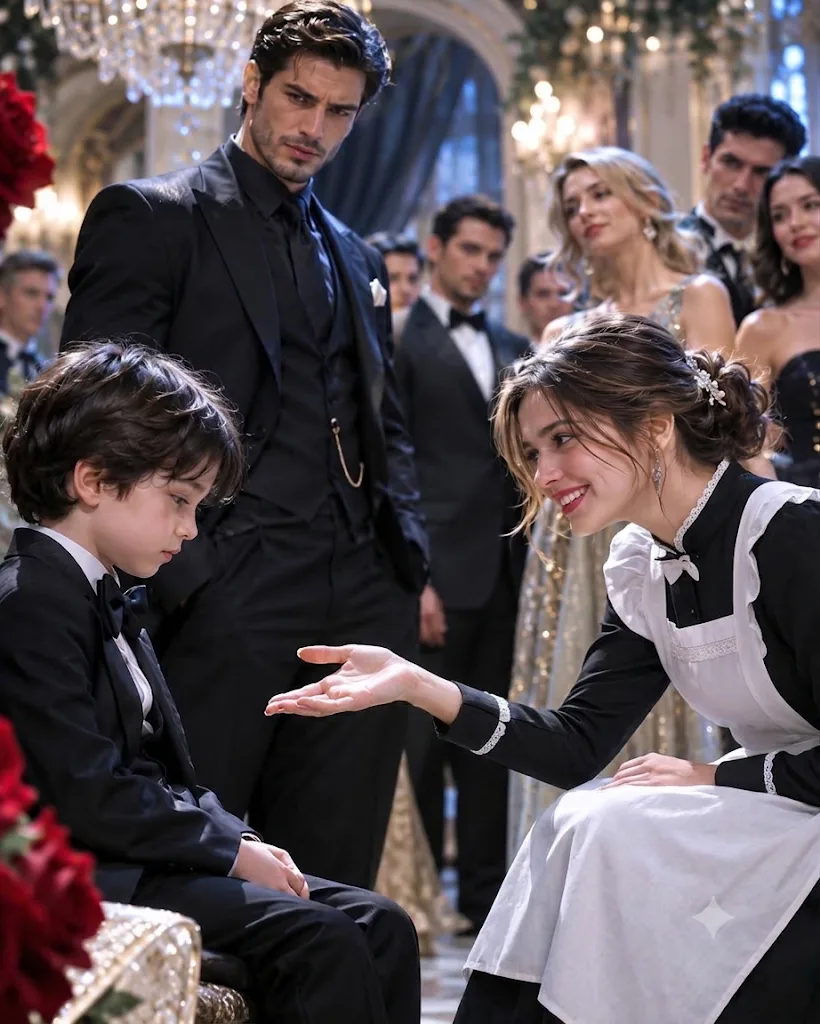
The ballroom did not simply grow quiet; it lost its pulse.
Five hundred people dressed in silk and diamonds stopped breathing at the exact same moment. The clink of crystal against silver ceased. The laughter of men who signed death warrants over dessert withered in their throats. On the far side of the room, near the velvet-draped terrace doors, the young boy who had uttered the word freak stood with his mouth slightly open, his champagne glass tilting in a limp hand until pale gold wine dripped onto his patent leather shoes.
Clara did not look at him. She did not look at the armed guards whose hands had strayed toward their tailored jackets, nor did she look at the agency coordinator, whose face had flushed from pale ivory to the color of ash.
Her world had narrowed to three feet of parquet flooring and a boy with wild dark hair.
Leo was not looking at her eyes. He was looking at the hem of her periwinkle dress, his dark eyelashes fluttering rapidly as if counting the folds in the silk. His small fingers, clamped so tightly around the brass train car that his knuckles were stark white, trembled against the sides of his head. He had not lowered his hands from his ears. To lower them would be to invite the room back in—the clinking glassware, the low vibration of the bass notes, the harsh glare of seven crystal chandeliers hanging overhead like jagged ice.
Clara kept her palms open and low, waist-high, resting on the empty air between them.
“You don’t have to let go of the train, Leo,” she said softly, keeping her voice in the mellow, rhythmic cadence she had used during her clinical rotations at Bellevue. “And you don’t have to listen to the room. It’s too loud in here. The ceiling is too high, and the lights are buzzing.”
At the word buzzing, the boy’s shoulders dropped a fraction of an inch.
He knew that sound. Clara had heard it the moment she walked onto the stage four hours ago: the subtle, high-frequency whine of the dimmer switches operating the thousands of miniature bulbs in the chandeliers. To the socialites sipping prosecco, it was imperceptible. To a nervous system stripped of filters, it was a drill pressed against the temple.
Leo’s gray eyes flicked upward, catching hers for a quarter of a second before darting back to her chest.
“The B-flat,” he whispered.
The words were so faint that had Clara not been leaning forward, she would have missed them entirely.
“The B-flat was out of tune,” Clara agreed, nodding slowly. “The technician tuned the piano on Thursday, but the air conditioning in this hall dropped four degrees when the guests arrived. The pin slipped. It sounded sour, didn’t it?”
A tiny exhale escaped the boy’s nose. He took one step back, pressing his spine firmly against the cool, smooth marble of the Corinthian pillar. Then, with deliberate, painful slowness, his left hand came down from his ear. It hovered in the air, hesitant, floating between them like a fallen leaf on water.
He did not offer his palm. He held out the front coupler of the miniature brass train.
Clara did not grab his hand. She extended her index finger, allowing the cold, heavy metal of the toy’s coupler to loop gently over her skin.
“We don’t need to spin,” she told him, her voice a steady anchor in the freezing vacuum of the room. “We can just count four beats. One, two, three, four. Like the train crossing a bridge.”
She shifted her weight from her right foot to her left. A gentle sway. No sudden movements, no performance, no smile designed for an audience. Just a metronome made of muscle and bone.
Leo took one step forward. His patent leather shoe met the parquet with a soft, scuffing click. He swayed with her—one, two, three, four.
A collective gasp, suppressed but undeniable, rippled through the perimeter of the ballroom.
In the four years since the car accident that had claimed the life of his mother, Leo Moretti had never allowed an outsider within arm’s reach. Tutors had been dismissed within hours; pediatric specialists flown in from Zurich and Boston had been met with violent, screaming meltdowns that left furniture broken and Dante Moretti’s wrath hanging over his household like a thunderhead. The boy did not touch. The boy did not engage.
Yet here he was, tethered by an inch of brass, swaying beside a woman in a thrift-store dress.
The illusion of quiet shattered not from sound, but from movement.
At the head table, thirty yards away, a high-backed mahogany armchair scraped backward against the marble.
Dante Moretti rose.
He stood six-foot-three, broad-shouldered beneath an Italian wool jacket cut with mathematical precision, his dark hair threaded with stark silver at the temples. His face was an unreadable mask of hard lines and old scar tissue, the pale gray of his eyes identical to the child’s. He did not look at his cousin, the groom. He did not look at the Capos who flanked him, men whose hands instinctively moved to clear a path.
He walked down the center of the dance floor.
Every guest pulled back, creating an avenue thirty feet wide. The silk dresses of society heiresses rustled as they shrank into the shadows of the pillars. The boy in the rented tuxedo who had called Leo a freak was pulled behind his father’s coat, the father’s face glistening with a layer of cold sweat.
Dante’s leather-soled shoes sounded like gunshots against the stone.
Clara did not break the rhythm. One, two, three, four. She felt Leo’s grip tighten around the brass train car, his posture stiffening as the shadow of his father fell over them. She kept her eyes on the boy, her thumb gently brushing the undercarriage of the toy, holding the bridge steady.
Dante stopped four feet away.
The scent of him arrived before his voice—expensive cedarwood, cold rain, and the faint, bitter metallic trace of gun oil that no amount of cologne could completely erase.
He looked down at his son. His gaze, notoriously lethal across three continents of shipping lanes and boardroom tables, softened by a single, microscopic degree.
“Leo,” Dante said. His voice was lower than the piano’s lowest octave, deep enough to vibrate in Clara’s sternum.
The boy did not look up, but he did not run. His small thumb stroked Clara’s finger.
Dante’s eyes shifted from his son to Clara. Up close, the intensity of his stare was suffocating. He had the eyes of an interrogator who already knew the answer to every question he had not yet asked. He took in her flushed skin, the cheap periwinkle fabric of her dress, the faint calluses on her fingertips that marked her as a true player, not a conservatory dilettante.
“What is your name?” he asked.
“Clara,” she said, her voice clear despite the dry terror coating her throat. “Clara Bennett.”
“You stopped playing.”
“The room was too loud,” Clara said simply, refusing to lower her chin. “Someone needed to change the tempo.”
A ripple of silent panic washed through the nearest ring of onlookers. To tell Dante Moretti that his event was flawed, that his room was disordered, was a death sentence for most men in New York.
Dante’s hand moved. He did not reach for a weapon; he reached inside his lapel, pulled out a heavy gold fountain pen, and turned his back on the crowd. He faced the ballroom, his silhouette commanding the five hundred souls frozen in place beneath the chandeliers.
“Luca,” Dante said, his voice quiet, conversational, and carrying with terrifying clarity to every corner of the cathedral-like hall.
His cousin, the groom, stepped forward from the dais, his hands shaking slightly against his cummerbund. “Yes, Dante?”
“The music agency,” Dante said, his eyes scanning the crowd until they found the agency manager, who looked as if she were about to lose consciousness against a pillar. “Cancel the contract. Pay them their balance and ensure they never book another event in this city.”
The manager let out a small, strangled whimper.
Dante did not look at her. He turned slightly, his gaze sweeping over the family of the boy who had spoken to Leo. The boy’s father, a shipping magnate named Vane, dropped his head, his hands clasped before him like a penitent in a confessional.
“Vane,” Dante murmured. “Your son’s manners reflect poorly on your household. Tomorrow morning at six, your commercial access to the Red Hook terminal is revoked. Pack your containers. You’re done in New York.”
“Dante, please—” Vane gasped, but a slight flick of Dante’s left hand silenced him instantly. Two armed men in black stepped silently behind Vane’s shoulders, guiding him backward toward the service exits.
Then, Dante looked back at Clara.
The silence in the room had mutated from fear into absolute, unadulterated awe. He extended his right hand—not to threaten, but with an open palm, mirroring the posture Clara had offered his son moments before.
“Miss Bennett,” Dante said, loud enough for every ear in the room to catch every consonant. “You are no longer an independent contractor. As of midnight, you are appointed as the private companion and master of education to my son, with full executive authority over his environment, his staff, and his residence.”
Clara stared at him, her chest seizing. “Mr. Moretti, I have a job. I have responsibilities in Queens—”
“Your sister Mia has stage-four glomerulosclerosis,” Dante said, cutting through her protest without raising his voice by half a decibel.
Clara froze. The breath left her lungs as if she had been struck with an iron pipe.
Dante took one step closer, his eyes boring into hers with the cold certainty of an omnipotent god.
“Her name is currently seventeenth on the regional organ transplant list at Mount Sinai,” Dante whispered, so close only she and the boy could hear him. “By tomorrow morning, she will be first. The best surgical team in North America will be waiting outside her room. Her treatments will be covered in perpetuity, and your debts will be erased from every database in this state.”
He looked down at Leo, who had finally let the brass train car drop to his side, his small face tilted upward, watching Clara with an intensity that broke her heart.
“In exchange,” Dante said, his eyes locking onto hers with an unyielding, unbreakable gravity, “you move into the Blackwood estate tonight. And you teach my son how to live in a world that wants to break him.”
Before Clara could draw breath to answer, the glass doors leading to the grand foyer burst open, and a man covered in road dust and blood fell onto his knees before the guards, shouting three words that made Dante’s hand snap to the grip of his pistol.
“The northern convoy,” the bleeding man wheezed, his fingers clawing at the polished parquet as two security guards pinned him by the arms. “Dante… they took the bridge. Santoro didn’t wait for the wedding to end.”
The name Santoro fell into the ballroom like a match tossed into kerosene.
The five hundred guests did not scream. They were too well-schooled in the etiquette of bloodshed to panic like common street pedestrians. Instead, a silent, coordinated retreat began. Women in beaded gowns moved briskly toward the private rear exits flanked by their personal security details; Capos muttered short, harsh directives into encrypted radio sets; the musicians on the riser packed their instruments with trembling, frantic fingers.
Dante did not look at the dying messenger. He did not look at the guests scurrying into the night like rats sensing a breached hull.
His eyes remained locked on Clara.
“Decision, Miss Bennett,” Dante said. His voice was entirely devoid of hurry, cold and rhythmic against the rising murmur of war around them. “The perimeter of this hotel will be sealed in two minutes. If you walk out into the street alone, you are a civilian in a city that is about to become very loud. If you walk out with my son, your sister receives her new kidney before dawn.”
Clara’s heart hammered against her ribs like a trapped bird.
She knew what this world was. Her father had worked as a low-level accountant for a logistics firm in Brooklyn until one day his sedan was found burnt to its steel chassis in the marshlands of Queens. She had spent ten years running from the gravity of men who solved balance sheets with hollow-point ammunition.
She looked down at Leo.
The boy had not moved. In the midst of the shifting crowd, the armed men running, the frantic clatter of retreating heels, Leo stood perfectly still, his eyes fixed on the hem of her periwinkle dress. He had taken his hands off his ears, but his small knuckles were white where he gripped his brass train. He had trusted her for four beats of a waltz. If she turned around and ran for the subway, the world would rush back in to swallow him whole.
And then there was Mia.
Mia, whose dialysis treatments left her shivering beneath thin hospital blankets, whose fifteen-year-old humor was running out of steam as her kidney functions dropped to single digits. Seventeenth on the donor list. Seventeenth meant twelve months. Mia did not have twelve months.
“Bring my sister to the estate,” Clara said, her voice shaking only on the first syllable before locking into iron. “Not a private clinic. To your house. Under your personal medical detail.”
Dante’s eyebrows rose a fraction of an inch—not with offense, but with the cold satisfaction of an executive who appreciated an aggressive counter-offer.
“Done,” Dante said.
He did not offer his hand to seal the deal. He turned his head slightly toward the shadow behind the marble pillar. “Marco.”
A man stepped out of the gloom. He was broad-shouldered, sixty years old, with hair the color of steel wool and a face carved by thirty years of street violence. He wore a simple black overcoat over a dark suit, his right hand resting inside his lapel.
“Take the boy and Miss Bennett through the service tunnels to the armored Maybach,” Dante commanded. “Take the river road. Avoid the bridges. If a single vehicle approaches within fifty yards, do not signal. Terminate.”
“Yes, Boss,” Marco said. His voice was a low gravel rumble. He looked at Clara, his dark eyes assessing her with the clinical detachment of a butcher examining livestock, before stepping between her and the retreating crowd. “Miss Bennett. Step behind me, please.”
Dante stepped closer to his son. He did not crouch—Dante Moretti did not kneel in public—but he reached down, his large, scarred hand hovering an inch above Leo’s shoulder, waiting for the boy to acknowledge him.
Leo did not pull away. He looked up at his father, his gray eyes unblinking.
“Go with her, Leo,” Dante murmured softly. “I will be home before the sun clears the river.”
The boy said nothing. He reached out with his free hand, took two fingers of Clara’s dress, and pulled gently. An imperative. Move.
They moved.
Marco led them through the discreet service door behind the orchestra riser, into a concrete labyrinth of service corridors that smelled of bleached linens, industrial dish soap, and cooling grease. Two guards with suppressed tactical submachine guns moved ten paces ahead; two more brought up the rear.
Clara felt the cold air hit her skin before she saw the alley.
The service bay opened onto a narrow street behind the hotel, where three black Mercedes Maybachs sat idling with their lights extinguished. The rain had turned into a fine, freezing mist that coated the asphalt in a slick sheen of black ice.
Marco opened the heavy, ballistic-reinforced door of the center vehicle. The interior was a cavern of dark leather, soft ambient amber light, and the quiet, pressurized hush of soundproof glass.
“Inside, Miss Bennett,” Marco instructed, scanning the rooftops across the street. “Keep his head below the window line.”
Clara helped Leo onto the wide leather bench. The moment the child’s boots touched the carpet, he curled his legs beneath him, pulled his knees to his chest, and set his brass train car on the armrest. He didn’t look scared; he looked exhausted, the adrenaline of the ballroom fading into the heavy, hollow stupor of sensory overload.
Clara slid in beside him. Before she could adjust her dress, Marco climbed into the front passenger seat, slamming the heavy door with a dull, vault-like thud.
“Go,” Marco said into the dash radio.
The Maybach surged forward without a sound, its V12 engine a muted vibration beneath their feet. The vehicle didn’t take the avenue; it cut through the industrial alleys of the West Side, weaving through the shipping container yards along the Hudson River like a black torpedo.
Clara pulled her phone from the small silk purse tucked into her waistband. Her fingers flew across the glass screen.
Mia, pack your bag. Someone is coming to pick you up. Do not argue. Do not call the nurse. Just get in the car.
The message had barely sent when the screen flickered, went black, and displayed a static-filled icon of a broken padlock.
“No outgoing transmissions, Miss Bennett,” Marco’s voice drifted over the headrest, cold and indifferent. “All signals within five yards of this chassis are jammed by the auxiliary scrambler. The Boss’s orders. Until the Santoro breach is contained, you do not exist on the cellular grid.”
Clara’s heart seized. “My sister—”
“A medical transport unit from Mount Sinai left twenty minutes ago with an armed escort,” Marco said, checking his side mirror. “She is already thirty miles ahead of us on the parkway. She has two board-certified nephrologists in the ambulance with her. Relax, girl. When Dante Moretti promises a life, he doesn’t use the postal service.”
Clara leaned her head against the cool glass of the window, watching the streetlights of Manhattan blur into long ribbons of yellow and red.
Beside her, Leo’s head began to droop. His small forehead leaned against her upper arm, his breathing slowing, the scent of lavender baby soap and expensive wool rising from his collar. His fingers, still curled around the brass train, relaxed their grip.
She did not pull away. She adjusted her shoulder, offering him a softer angle to rest against, her thumb gently stroking the fabric of his sleeve.
Up in the front seat, Marco glanced into the rearview mirror. His hardened eyes lingered on the boy’s head resting against Clara’s arm for three long seconds. He didn’t speak, but his hand moved away from his sidearm, resting flat on his knee.
The car crossed the northern boundary of the city forty minutes later, leaving the high-rises behind for the dark, winding roads of Westchester County.
Here, the trees grew thick and ancient, their bare winter branches arching over the blacktop like the ribs of a rotting cathedral. There were no streetlights, no commercial signs, no passing sedans. Only the high, stone security walls running continuously along the right side of the road, topped with black wrought-iron spikes and the discreet, blinking red lights of motion-activated security cameras.
The Maybach slowed.
Ahead, rising out of the mist like a medieval fortress, stood the gates of the Blackwood estate.
They were thirty feet of blackened iron, forged with the Moretti family crest—a crowned serpent coiled around a broken blade. Beyond the gate, a winding private drive climbed through two hundred acres of old-growth oak and pine, leading toward a massive, three-story mansion of gray granite and black slate.
The estate did not welcome guests; it challenged them. High floodlights bathed the gravel forecourt in stark, operating-room white, illuminating eight armed men in tactical gear patrolling the perimeter with Belgian Malinois patrol dogs.
The car stopped before the main portico.
Marco stepped out, opening Clara’s door. “Welcome to Blackwood, Miss Bennett. The Boss’s aunt is waiting in the grand salon. I suggest you remember that in this house, silence is the only currency that doesn’t depreciate.”
Clara carefully lifted Leo into her arms. He was sound asleep, his small body heavy with the limp trust of an exhausted child. She stepped onto the frozen gravel, her periwinkle dress whipping in the bitter northern wind, and looked up at the towering granite facade.
As she crossed the threshold into the great hall, a woman stood at the base of the sweeping marble staircase.
She was fifty, dressed in an immaculate high-collared gown of emerald velvet, her silver-streaked hair pulled back into a severe bun that looked like it had been carved from bone. Her features were sharp, aristocratic, and ruined by a sneer of pure, undiluted aristocratic hatred.
Beatrice Moretti. Dante’s aunt, and the matriarch who had managed the family’s domestic affairs since Leo’s mother had died.
Her cold, dark eyes swept over Clara’s thrift-store dress, the mud on the hem of the periwinkle silk, and finally settled on the sleeping boy clutched against her chest.
“So,” Beatrice said, her voice dripping with the venom of a serpent coiled on silk. “This is the charity case Dante picked up off the dance floor. Tell me, girl… did you think that touching my nephew’s son gave you a title to this house?”
Before Clara could answer, a loud, concussive boom echoed from the front gates three miles down the drive, followed by the immediate, deafening wail of the estate’s interior sirens.
The sirens inside Blackwood were not the shrill, mechanical shrieks of city alarms. They were a low, resonant baritone horn that vibrated through the five-foot-thick granite blocks of the foundation, setting the crystal pendants of the grand foyer chandelier into a violent, musical shiver.
Leo did not scream. He did not jump.
He woke instantly, his body locking into an iron rigidity against Clara’s chest, his small fingers digging so hard into the soft flesh of her shoulder that she felt the skin pinch beneath the silk. His breath came in fast, shallow gasps, his gaze darting across the high vaulted ceiling like a bird trapped inside an engine room.
“Down,” he whispered. The word was frantic, clipped, repetitive. “Down. Down. Down.”
Clara ignored the woman in emerald velvet standing five feet above them on the marble staircase. She knelt on the cold, black-and-white checkered floor, keeping her posture low, her arms forming a protective enclosure that gave him space without abandoning him.
“You’re on the ground, Leo,” she said, her voice dropping into that deep, slow therapeutic tempo that refused to match the panic of the sirens. “Feel the floor. It’s granite. It’s cold. It doesn’t move. Count four tiles. Black, white, black, white.”
The boy dropped to his hands and knees, his forehead pressing against the cold stone. His right hand found the brass train car in his pocket, planting it firmly on the black grout line.
“Black,” he muttered through clenched teeth. “White. Black. White.”
“What is the meaning of this theater?” Beatrice Moretti snapped, descending two steps, her emerald skirt hissing against the marble like a disturbed viper. “Get that child off the floor! Marco, why are the gate sensors tripping? If Santoro’s mercenaries have breached the lower woods, why are you standing here watching a scullery maid play games with my nephew’s heir?”
Marco didn’t look at her. He had his submachine gun up, his broad back planted against the massive oak entry doors, his headset crackling with static.
“North gate perimeter fence was cut, Donna Beatrice,” Marco reported, his voice flat as granite. “Two utility trucks through the barrier. It’s not Santoro’s main force. It’s a diversion team. Four men with incendiary charges, trying to draw our tactical unit away from the river road.”
“Then extinguish them!” Beatrice hissed, her nostrils flaring. “You have fifty men under arms on this property!”
“They’re already being handled,” Marco replied, not moving an inch. “The Boss’s orders were specific: I do not leave Miss Bennett or the boy. Even if the roof falls in.”
Beatrice’s sharp, aristocratic face contorted into something ugly and venomous. She looked at Clara, who remained on her knees beside Leo, her hand resting two inches above the boy’s back, providing presence without the sensory friction of touch.
“You,” Beatrice said, pointing a long, manicured finger tipped with oxblood polish at Clara’s face. “You think because Dante made a dramatic speech in front of his Capos that you have a purpose here? You are a distraction. A street girl hired to soothe an embarrassment we have kept out of the public eye for four years. Stand up. Hand the boy to his nurse.”
Clara slowly lifted her head.
She had spent six years dealing with condescending doctors in oncology wings, with bureaucratic hospital administrators who looked at her sister’s insurance forms as if they were trash, and with landlords who threatened to shut off the radiator in December. She had run out of deference a long time ago.
“No,” Clara said.
The word was not loud, but in the echoing expanse of the grand foyer, against the rhythmic baritone of the sirens, it landed with the concussive weight of a dropped anvil.
Marco’s eyes flicked to her in the reflection of the glass transom. One of the armed guards near the door actually coughed to mask a sudden laugh.
Beatrice’s mouth parted in pure, unadulterated shock. “Excuse me?”
“I said no,” Clara repeated, rising smoothly to her feet, smoothing down the torn, oil-stained hem of her periwinkle dress. “He’s in a sensory overload spiral. If his nurse comes near him right now with whatever sedative you usually use to keep him quiet, his heart rate will spike into ventricular tachycardia. He doesn’t need a syringe. He needs the alarm turned off, he needs this light lowered by forty percent, and he needs you to stop shouting from the third step.”
“How dare you—!”
“Marco,” Clara said, turning her back on the matriarch of the Moretti family without a second thought. “Where is the main breaker for the foyer chandeliers?”
Marco blinked. In forty years of serving the Five Families, he had seen men flayed alive for speaking to Beatrice Moretti with less insolence. But he had also seen the look in Dante Moretti’s eyes on that dance floor. He knew whose authority carried the real lead in this house.
“Under the stair alcove, Miss Bennett,” Marco said, nodding toward the shadow beneath the grand risers. “Secondary panel. Third switch from the left.”
Clara walked across the marble, found the recessed brass panel, and flipped the switch down.
The massive crystal chandelier overhead died.
The harsh, blinding glare vanished, replaced by the soft, warm amber glow of two low-wattage library sconces flanking the fireplace. The high-frequency buzz that had been vibrating through the ceiling immediately dropped out of the air.
In the sudden, gentle gloom, Leo let out a long, ragged sigh that sounded like an engine finally cooling down. His forehead remained pressed against the marble, but his fingers loosened their death-grip on the grout line.
“One, two, three, four,” the boy whispered into the stone. “The bridge is safe.”
Beatrice looked from the darkened chandelier to Clara, her chest heaving with a rage so potent it made the emerald velvet of her bodice shake.
“You have made a fatal error, Miss Bennett,” Beatrice whispered, her voice dropping into a register of pure, aristocratic poison. “Dante is a man of impulse. He saw an opportunity to humiliate his enemies tonight, and he used you as the instrument. But when the sun comes up, when the Santoro threat is buried in the marshes, this house returns to my governance. And I promise you… you will not survive the week.”
A sudden, sharp mechanical chirp echoed from Marco’s tactical radio.
The guard pressed his ear piece, listened for three seconds, and then lowered his weapon. The exterior sirens died, leaving only the crackle of the wood fire in the great hearth.
“The diversion is cleared,” Marco announced into the room. “Three hostile casualties. One prisoner taken for the cellar.”
The heavy front doors of the mansion were pushed open from the outside.
A cold, wet wind blew into the foyer, carrying the smell of cordite, wet wool, and blood.
Dante Moretti stepped across the threshold.
His suit jacket was gone. His white linen shirt was soaked through with rain, the sleeves rolled to his elbows, displaying the thick, black ink of old Sicilian tally marks running up his forearms. A dark smear of arterial blood was dried across his left collarbone. In his right hand, he held a black leather briefcase; in his left, he held a plastic hospital intake folder stamped with the seal of Mount Sinai.
He didn’t look at his aunt. He didn’t look at Marco.
His gray eyes swept the darkened foyer, took in the extinguished chandelier, and found Clara standing beneath the stair archway with her chin held high.
Dante walked across the marble, stopped two paces away, and dropped the hospital folder into her hands.
“The donor match was verified thirty minutes ago,” Dante said, his voice quiet, steady, and filled with a terrifying, absolute authority. “Mia was admitted to the VIP surgical suite on the tenth floor. Her operation began at midnight. Dr. Rossi is the lead surgeon. He has a ninety-nine percent survival rate.”
Clara looked down at the folder. Her name was printed on the legal guardian release form, signed with Dante’s sweeping, aggressive hand in black ink. Her knees finally buckled—not from fear, but from the sudden, overwhelming removal of a burden she had carried alone for three years.
Dante reached out, his large, calloused hand catching her elbow before she could hit the floor, his grip firm, warm, and unbreakable.
“You don’t kneel in this house, Miss Bennett,” he murmured, his thumb brushing against the fabric of her sleeve. “Not to my enemies. Not to my family. And not to me.”
From the floor behind them, a small, metallic sound echoed across the stone.
Clink.
Dante turned.
Leo had stood up. He had not retrieved his brass train car from the floor; he had left it sitting squarely on the black tile. He took three slow, deliberate steps toward his father, stopped two feet away, and looked directly into Dante’s blood-spattered face.
Then, the boy who had not spoken a full sentence to his father in four years opened his mouth.
“She stayed,” Leo whispered.
Dante froze. For the first time in Clara’s presence, the iron mask of the Don slipped, revealing the raw, bleeding hollow of a father who had spent four years starving for a single crumb of his son’s voice.
Before Dante could answer, the heavy leather briefcase he had dropped on the table popped open, spilling a series of black-and-white surveillance photographs across the mahogany—photographs that made Marco draw his breath in a sharp, horrified hiss.
