
PART 1 — The Bed Beside the Flour
The dashboard clock in our aging Subaru shone an unforgiving 2:00 a.m. I was trembling, though the Pennsylvania cold battering the frosted windows wasn’t entirely responsible. What had happened inside my in-laws’ farmhouse had left a chill no heater could reach. Beside me, Daniel held the steering wheel with carefully restrained force. My husband was accustomed to carrying responsibilities that stretched far beyond our household. Yet that night, it was the weight of his own family that threatened to break his composure. Before we reached the road home, Christmas had become something neither of us could pretend away.
Hours earlier, on Christmas Eve, 2025, we had driven from our peaceful home outside Lancaster to his parents’ sprawling farmhouse near Lititz. Sleet had made the highways treacherous, but the familiar anxiety waiting at our destination troubled me more. I was forty-two, a former army logistics officer who had spent twelve demanding years in uniform before becoming a corporate director. Daniel was forty-five. His relatives still called him “Danny,” treating him as a reliable but unimpressive career enlisted soldier—a man useful for following instructions, repairing things, and asking for nothing in return.
Their understanding of his career was wrong. Daniel was a senior military officer whose work required encrypted communications even during family holidays. His responsibilities were confidential, and he had little desire to expose his volatile relatives to the visibility surrounding his command. So he had let them retain their comfortable assumptions. Around them, the authority he carried elsewhere disappeared beneath a patient smile. His mother, Margaret Hail, found that version of him convenient. She organized family life through calculated slights and rigid expectations, assigning value to people as carefully as she arranged the napkins at her holiday table.
That morning, I had packed our car with wrapped presents, specialty groceries, and an enormous French toast casserole I had spent the previous evening preparing. While Daniel carried the cooler down our driveway, his secure phone sounded. He stepped aside, his voice acquiring the quiet authority his family never heard. Then he returned, kissed my forehead, and surveyed the provisions. “You’ve secured the perimeter, I see,” he joked. “Unless she expects a spare oven, we’re fully supplied.” I wanted his confidence to settle the unease tightening inside me. “I want to believe that,” I murmured. Experience made believing difficult.
The farmhouse welcomed us with the smells of roasting ham, warm cider, and pine. Its charm lasted until Margaret appeared in the foyer and examined me as though I had arrived for inspection. “Rebecca,” she stated. “Good, you’re here. Did you secure the citrus?” I answered, “Yes, Margaret. And the heavy cream.” Walter, Daniel’s father, embraced us warmly. A retired electrician, he had gentle manners and hands permanently marked by working life. His welcome barely had time to register before Margaret issued instructions. “Rebecca, the kitchen requires your immediate attention,” she commanded. Our coats were not even unbuttoned.
The next five hours disappeared into chopping, scrubbing, lifting, and carrying. I cut celery, washed treasured serving platters, and fetched heavy boxes of porcelain from the damp cellar. Hard work was familiar; being treated as though the worker did not exist was something else. In the army, effort had carried purpose and earned respect. Here, it merely kept Margaret’s holiday running while everyone looked elsewhere. During the afternoon, Walter’s tenant called about a frozen pipe that had burst at a rental property. Daniel volunteered to meet the plumber. “Don’t hold the rations for me,” he said, collecting his coat. Margaret waved him away. “We’ll manage Rebecca.”
Not long afterward, Vanessa arrived with her husband, Paul, and their twenty-two-year-old daughter, Clara. Daniel’s older sister swept through the entrance carrying a bakery box as though she had personally rescued Christmas. “Mom! I brought the dessert!” Vanessa announced. Margaret showered her with gratitude over the purchased sugar cookies. From the kitchen sink, where the evidence of my own contribution surrounded me, I watched the celebration. Clara drifted toward me instead. “Need reinforcements, Aunt Rebecca?” Before I could accept, Margaret intervened. “No, darling,” she said sweetly. “Go rest. You’ve had a strenuous twenty-minute drive.”
Dinner continued the same arrangement: my work remained useful, and my presence remained incidental. Afterward came the sleeping assignments. Although the farmhouse was large, available space apparently vanished the moment my name entered the discussion. Vanessa and Paul received the grand master suite. Clara was given the airy corner bedroom. Aunt Judith, Walter’s formidable older sister, was settled downstairs because of her aching joints. I expected Margaret to lead me to the den, where Daniel and I usually stayed. Instead, she stopped outside the narrow pantry and opened its door. The room beyond it had no heat.
A canvas folding cot had been forced between canned beans, paper towels, and bulk supplies. Silver duct tape supported one metal leg. “Your quarters, dear,” Margaret announced. I stared at the cramped space. “The pantry? What about the pull-out sofa in the den?” Her answer came smoothly. “Reserved,” she said, “for the grandchildren tomorrow.” I knew that explanation made no sense. “They aren’t staying the night, Margaret.” Her expression hardened at the challenge, stripping away the thin courtesy she had maintained. The house was full of proper beds, yet she expected me to believe this damaged cot was the only possibility.
“Rebecca, do not initiate hostilities. The house is at capacity. Daniel can bunk with Walter when he returns. A soldier like him is used to the floor anyway. It is one night.” Margaret turned away, leaving no opening for discussion. Then she added, “Be operational by 0400 hours. You are cooking breakfast for eighteen.” I remained in the doorway, surrounded by the smell of flour and onions, trying to absorb the instruction. Eighteen people, one cook, and almost no sleep. Vanessa passed behind her mother and glanced inside. “Oh, look!” she chirped. “Your own private culinary suite!”
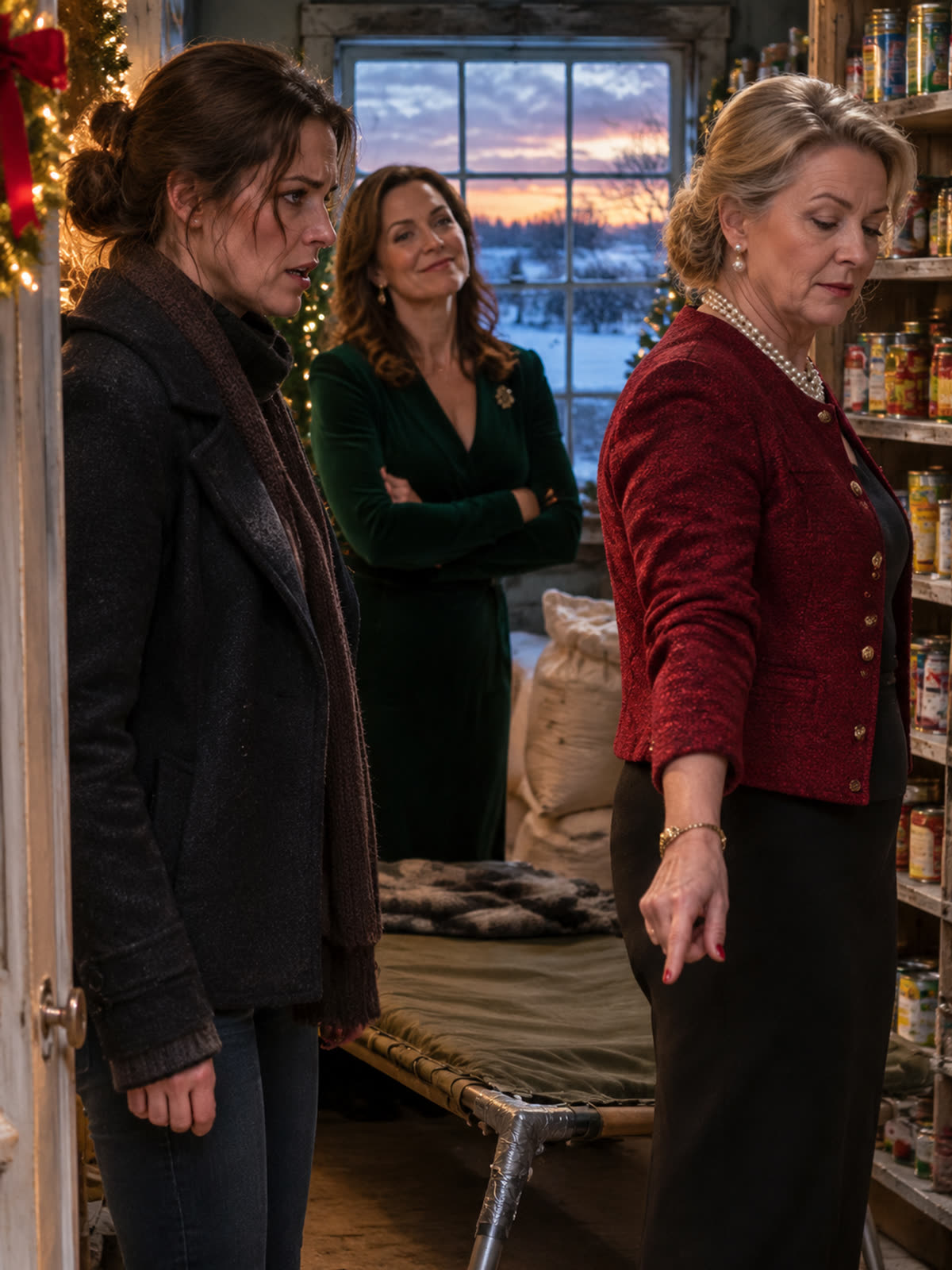
I said nothing. Anger rose fiercely enough that I could have emptied years of resentment into that hallway, but I knew how quickly my reaction would become the family’s preferred subject. I changed into sleepwear in the pantry’s cold shadows and stretched out beneath a thin blanket. Beyond the wall came laughter and the muffled sound of holiday television. The canvas sagged beneath me, and the taped cot leg complained whenever I moved. I told myself I could last one night. Then the front door closed heavily. Familiar boots crossed the floor, and the pantry handle began to turn.
Daniel filled the doorway, carrying the cold night on his heavy wool coat. His gaze moved from the repaired cot leg to the flour sacks beside my pillow. He understood the arrangement almost immediately. “My mother informed me you requested a secluded space to rest,” he said, his voice dangerously quiet. I pushed myself upright, my back protesting. “She told you that?” His jaw tightened. “Did she order you into this space?” Drawing the inadequate blanket around me, I nodded. “And she expects me to commence breakfast operations at 4:00 a.m. for eighteen guests.”
The change in him was immediate. The accommodating son disappeared, and the commander stood in his place. He reached for my coat on the rusted hook. “Gear up,” he commanded softly. “We are extracting.” I hesitated, already anticipating the uproar. “Daniel, your mother is going to initiate a scorched-earth campaign.” He held the coat open, his expression filled with controlled, protective anger. “Let her kingdom burn in her own kitchen.” I put on my boots without lacing them, collected my overnight bag, and followed him through the dark corridor toward the front door. We nearly reached it before the lights blazed on.
Margaret stood above us on the staircase, pulling the belt of her velvet robe tight. “Daniel,” she barked. “Where on earth are you deploying her at this hour?” His hand remained on the brass doorknob as he turned. “It is 2:00 a.m., Daniel,” she continued, descending two steps. “Have you both lost your minds?” He did not lower his eyes. “Rebecca will not be sleeping in a supply closet, Mom.” Margaret looked genuinely offended. “Oh, for heaven’s sake, Daniel! She’s military. You’re military. It’s a cot. Why are you acting like I’ve sent her to the gulag?”
“If it’s merely a cot, why didn’t you assign it to Vanessa?” Daniel asked. “Vanessa is married!” Margaret replied. “So is Rebecca.” The floorboards creaked, and Vanessa appeared in silk pajamas. “What is this disturbance? Mom, what are they doing?” Margaret immediately supplied her version. “Your brother is deserting us,” she proclaimed. “Apparently, Rebecca finds our hospitality beneath her.” Heat climbed into my face, but my voice stayed steady. “It is not just the cot, Vanessa,” I said. She rolled her eyes. “Oh, here we go,” she groaned. “Always the victim.”
Daniel stepped between us. “Do not address my wife in that tone.” Vanessa scoffed. “She is manipulating you! She’s turning you against your own blood!” His answer carried a finality that silenced the stairwell. “No,” he replied. “I am finally observing how you treat her. There is a kitchen fully stocked with provisions and a house full of capable adults. You can make your own breakfast.” He opened the door, admitting a rush of bitter winter air. “Good night, Mom.” We left their bright hallway behind, and only once we were in the Subaru did I realize how badly I was shaking.
The drive passed through dark farmland, with distant Christmas lights glowing against the winter landscape. Eventually Daniel spoke. “Why didn’t you contact me immediately?” I watched frost gather on the window. “You were assisting Walter,” I replied quietly. “And I knew the tactical outcome. Your mother would paint me as the aggressor. Vanessa would flank her. The entire holiday would become a referendum on my character. I calculated I could endure one night to keep the peace.” He changed gears. “You shouldn’t have to endure my family, Rebecca.” The tenderness in that answer nearly undid me.
I could handle difficult operations, hostile meetings, and relentless workloads. His understanding was harder to withstand. “She told you I wanted a quiet room,” I whispered. “Did she mention the den?” He gave a bitter laugh. “She claimed it was needed for the grandchildren. But Clara is the youngest, and she has a bed.” Then he asked, “This isn’t an isolated incident, is it?” In the dark car, I finally told him about the Thanksgivings I financed and cooked while Vanessa received the praise, the portraits I took instead of appearing in, and the cutting remarks about my “masculine” military background.
We reached home at three. Our modest house, crooked Christmas tree, and mismatched ornaments felt safer than any grand farmhouse. Daniel cooked bacon, and later we ate eggs at our own kitchen table. At eight, the family chat erupted. Vanessa: Some people think they are royalty and too good to help their own family on Christmas. Margaret: Eighteen people waiting for breakfast. And Rebecca stages a dramatic walk-out. Daniel extended his hand. “May I?” I gave him my phone. His response was precise: Daniel: Rebecca was assigned a folding cot in a freezing pantry while proper quarters were vacant. She was ordered to single-handedly cook for eighteen people. As her husband, I initiated our departure. Cease your unfounded attacks on her immediately.
The messages stopped. Then Aunt Judith replied: There are three grown women in that kitchen and a functional stove. I assess you will survive the morning without her. Exhausted laughter escaped me, genuine for the first time that holiday. For a few hours, I believed the worst had passed. But later that afternoon Judith called, and there was nothing amused in her voice. “Rebecca, I am glad Daniel extracted you. But the pantry is a mere skirmish. You need to know about the massive fraud Margaret is perpetrating.”
PART 2 — The Names in the Ledger
I sat rigid at our kitchen table, the remains of Christmas breakfast pushed aside, and tightened my grip on the phone. “Fraud? What do you mean, Judith?” I asked. A long sigh came through the speaker over the distant sound of a televised parade. “Honey, your mother-in-law has been running a sophisticated disinformation campaign. She has been informing the entire extended family—and half the congregation at her church—that you and Daniel are financial parasites. She claims Vanessa single-handedly funds the family gatherings, and that Daniel refuses to contribute a dime to his aging parents.”
Across the kitchen, Daniel was carefully drying a cast-iron skillet. For a moment, the audacity of what Judith had said left me unable to breathe normally. “Judith, that defies all logic. I have physically purchased, transported, and cooked the majority of those meals.” Her reply was gentle. “I am aware,” she said. “But last Thanksgiving, while you were elbow-deep in turkey grease, Margaret stood in the parlor and told everyone that Vanessa had paid for the entire spread, and that you were simply ‘overseeing’ the kitchen because you had a ‘need for control’.”
That Thanksgiving returned to me with painful clarity. Two days spent gathering ingredients. More than five hundred dollars at the supermarket. Containers purchased so everyone could carry leftovers home. Vanessa, meanwhile, had arrived twenty minutes late holding one store-bought pumpkin pie. “I paid for everything,” I whispered. The betrayal burned in my chest. “I suspected as much,” Judith answered. “Do not allow that woman to convince you that maintaining the peace requires accepting her fictional narrative.” When we hung up, I repeated the conversation to Daniel. He set the skillet down carefully. “We are conducting a full financial audit,” he declared.
For forty-eight hours, our dining room became a workspace crowded with bank statements, receipts, credit card records, and confirmation emails. We searched three years of transactions, not for a satisfying accusation but for facts no one could dismiss. I recognized the disciplined distance settling over me: the same approach I had once used when an operation required clarity rather than emotion. We divided the spreadsheet into Direct Household Assistance, Infrastructure Repairs, and Family Operations (Gatherings). Each entry needed its supporting record. Gradually, what had felt like scattered favors began to form a much larger picture.
There was eight hundred dollars for the emergency water heater replacement. Six hundred for repairs to the porch, which Margaret had described as dangerous for Walter. There were the regular payments Daniel had quietly sent to make his parents’ retirement easier. Then came the gatherings: groceries, flowers, bakery orders, and the nonrefundable catering deposit for Walter’s seventieth birthday. I found a receipt for forty-eight artisan rolls and two enormous sheet cakes. Daniel studied the screen. “Forty-eight rolls. They consume carbohydrates like an invading army preparing for a winter siege.” His attempt at humor never reached his eyes.
By the time we finished, the total exceeded twenty-eight thousand dollars. We lived comfortably, but that figure represented a substantial share of our resources. Between my civilian salary and the modest professional identity Daniel maintained outside his confidential responsibilities, we had never presented ourselves as people with money to scatter carelessly. He leaned back and rubbed the bridge of his nose. “I operated under the assumption Vanessa was matching our contributions,” he said. I looked up from the records. “Did Margaret explicitly state that?” He considered it. “She heavily implied it. Every time she requested funds, she mentioned how hard Vanessa was working to ‘do her share’.”
Daniel called his mother while I sat beside him. There was no small talk. “Mom,” he began. “We require clarification regarding the financial capital we’ve been injecting into your household.” Margaret immediately became defensive. “I never demanded a single penny from you, Daniel.” He consulted the spreadsheet. “March 15th. You contacted me in distress regarding an overdue municipal utility bill. June 2nd, the porch repair. You stated Dad was in physical danger.” She answered sharply, “Those were unforeseeable emergencies!” He did not dispute that we had chosen to help. What mattered was the false story she had built around that help.
“Understood. We provided the capital willingly. The primary issue is your ongoing campaign of slander, informing the family that Rebecca contributes nothing to this family, both physically and financially.” Silence followed. Then Margaret replied, “I have no idea who is feeding you this paranoia, Daniel. Am I expected to maintain a ledger of every casserole deposited in my kitchen?” He refused the diversion. “Rebecca financed the entirety of Thanksgiving,” he said. “Well, Vanessa assisted as well! She brought dessert!” Margaret snapped. Daniel’s reply was immediate. “Vanessa contributed an eight-dollar pie. Rebecca contributed five hundred dollars in raw materials and twenty hours of labor.”
Margaret abandoned the facts entirely. “You are being petty, calculating, and wildly ungrateful. You are tracking money like a miser!” Daniel studied the same records she wanted him to feel ashamed of keeping. “Effective immediately, all discretionary funding is terminated. We will honor the pending plumbing contract by paying the vendor directly. We will not subsidize another holiday, nor will we provide unrestricted capital. Good day, Mom.” He ended the call. The decision was not a demand for repayment. It was a boundary, and even in the quiet afterward, I could feel how profoundly it altered the arrangement his mother had taken for granted.
Ten minutes later, Vanessa called me. “What kind of psychological warfare are you waging against Mom?” she screamed. “She is inconsolable! You are turning my brother into a monster!” I looked at the receipts spread across our table. “Vanessa,” I replied, “I am not requesting reimbursement. I am demanding the cessation of her slander.” She raised her voice again. “You have always kept score, Rebecca! You’re obsessed with control!” This time, I did not scramble to make my answer easier for her to accept. “If I were keeping score, Vanessa, you would have lost three years ago.” I ended the call.

That evening, while folding laundry, I felt the anger recede into an emptiness that was almost worse. For nearly ten years, I had behaved as though enough work, generosity, and restraint might eventually earn acceptance. Instead, those qualities had become convenient tools for maintaining my place beneath Vanessa. My willingness to absorb the insult had helped disguise it. Yet even then, we did not understand the full financial picture. On December twenty-ninth, Paul called Daniel. The uneasiness in his voice was unmistakable. “Daniel,” he began. “I need to ask you a highly sensitive question regarding the farmhouse property taxes.”
“I handle our internal budget,” Paul continued. “Vanessa has been broadcasting to the extended family that she has been valiantly paying your parents’ massive property tax bills, saving them from foreclosure.” He paused. “Daniel… we haven’t sent them a dime for taxes. In fact, Vanessa’s side business has been bleeding money, and we can barely cover our own mortgage. Have you been paying the taxes?” Daniel looked at me. “Paul,” he said evenly. “I have not paid their property taxes. But I have sent my mother three massive, separate transfers this year for ‘medical emergencies’ and ‘insurance adjustments’.”
Paul swore softly. “Daniel… she’s not paying the taxes with it. Vanessa’s failing boutique… Mom has been funneling the money you send her directly to Vanessa to keep her business afloat, while telling everyone Vanessa is the one saving the family.” The information struck with a force the receipts alone had not carried. Margaret had taken money she believed her unremarkable soldier son worked hard to earn, redirected it toward her favorite child, and publicly reversed the roles. Vanessa became the rescuer. Daniel and I became the burdens. “We need actionable intelligence from the ground,” I told him. “We need to speak to your father.”
Two days later, we visited while Margaret and Vanessa were attending a church luncheon. Without his wife directing the house around him, Walter seemed older and unusually tired. “Enter,” he said, stepping aside. “I brewed coffee.” We sat at the familiar kitchen table. Daniel approached him gently rather than as someone to be accused. “Dad, we need to discuss the household finances. Specifically, the capital I’ve been transferring to Mom.” Walter released a heavy breath, stood, and fetched a battered blue spiral notebook from a high cupboard. The simple object seemed entirely ordinary until he set it between us.
“I was a union electrician for forty years, Daniel. I don’t understand modern banking apps. I understand ledgers. I have recorded every expense that enters and exits this structure.” He opened to November 2024. “I record the materials. Margaret records the benefactors,” he explained. Walter’s neat block lettering listed poultry, vegetables, disposable supplies, and centerpieces. Beside those entries, Margaret’s sweeping cursive supplied one name: Vanessa. On the December pages, the bakery order, fruit arrangements, and catering deposit carried the same attribution. I recognized purchases I had made myself. Seeing her claim written down turned my anger cold and precise.
“Walter,” I said quietly, struggling to keep my voice from shaking. “I purchased those items. Every single one.” He adjusted his spectacles and studied the page. “I was aware you transported the supplies, Rebecca. I operated under the assumption you were assisting Vanessa with her purchases.” Daniel turned to the months of the supposed medical emergencies. No corresponding medical expenses appeared. Instead, Walter had written a marginal note: Cash withdrawn. Margaret assisting V. with inventory. Daniel shut the notebook. “Dad, Mom hasn’t just been lying about the groceries. She has been taking the emergency funds I send you and funneling them into Vanessa’s failing business.”
Walter gripped the table until his knuckles whitened. “I knew she favored the girl,” he whispered. “I knew Vanessa’s shop was struggling. I did not know… I did not know she was harvesting you to feed her.” Daniel’s hurt broke through. “Why did you never question the grocery names, Dad?” Walter looked directly at me, shame filling his expression. “Because it was easier to believe Margaret’s narrative than to confront the reality of her cruelty. And for that, Rebecca, I am profoundly sorry.” His admission was painfully honest. But an apology could not substitute for exposing what had happened.
In the Subaru afterward, Daniel’s anger finally pressed against its restraints. “I am going to call the Inspector General—or the civilian equivalent,” he said. “I am going to freeze their accounts. I am going to tear that house down to the studs.” I stopped him. “Negative,” I said. “Emotional detonations yield messy results. Margaret is planning a ‘Family Summit’ on New Year’s Day to address our ‘disrespect.’ She expects to ambush us, to publicly shame us into compliance. We will let her gather her troops. And then, we will present the evidence. We will dismantle her narrative in front of her entire audience.” He glanced at me. “Copy that.”
The remaining days passed under a weight of anticipation. On New Year’s Eve, Clara sent a photograph. Her message read: Clara: Aunt Rebecca, I found this pinned behind the calendar on the fridge. I thought you should see the battle plan. I enlarged the image. A yellow legal-pad sheet, dated December twenty-third, carried the heading Christmas Eve Billeting. It listed the room assignments exactly as Margaret had distributed them. At the bottom, my name had been underlined twice in red. The instruction read: Rebecca: Pantry. 0400 hours breakfast duty. Do not alert Daniel.
I handed Daniel the phone. Until that moment, Margaret might still have tried to hide behind confusion, crowded rooms, or a practical decision badly received. The dated instructions destroyed those excuses. She had planned the isolation before we arrived and deliberately kept her son uninformed. He stared at the red marks, and whatever remained of his instinct to protect her fell away. “She didn’t just stumble into cruelty,” he said softly. “She drafted a battle plan. Tomorrow, she finds out what happens when you ambush a superior force.”
PART 3 — The Family Tribunal
New Year’s Day arrived beneath a gray sky heavy with the threat of ice. The cold seemed to sharpen everything, including the care with which I dressed. I chose a tailored black blazer and crisp slacks, clothing that felt like familiar armor without being a uniform. Daniel put on a dark sweater. Nothing about it announced his position, but his bearing did. He stood with the rigid composure he usually softened around his family. This time, there would be no harmless version of Danny offered for their convenience. At precisely 1300 hours, we reached the farmhouse.
The Christmas decorations still covered the rooms, though their cheer now looked strained and exhausted. I could not separate the ornaments from the work that had supported the celebration or from the pantry hidden beyond it. Aunt Judith answered the oak door. Her eyes moved over our empty hands, then settled on Daniel’s expression. A grim smile appeared. “I see the supply lines have been permanently severed. Excellent.” We had brought no groceries to unload, no casserole to warm, and no offerings meant to purchase a welcome. The only thing we had come to provide was the truth.
Margaret had arranged the living room into a semicircle, placing her high-backed armchair at its center of authority. Vanessa occupied the position beside her. Paul sat farther away, studying his fingernails with an intensity that made his discomfort obvious. Walter, several cousins, and other aunts completed the gathering. Two wooden folding chairs waited in the middle, separate from the rest. Margaret gestured toward them. “Take a seat. We have much to discuss.” The arrangement needed no explanation. She had assembled an audience and assigned us the place from which we were supposed to defend ourselves.
Daniel ignored the chairs. He walked into the center of the room and remained upright, hands loosely clasped behind his back. I stood a little behind him. “We prefer to stand, Mom,” he said. He did not raise his voice, but its resonance changed the room. Several cousins straightened almost involuntarily. Margaret narrowed her eyes. “Daniel, you will sit. We are not children to be disciplined. We are here to address the catastrophic scene you and your wife caused on Christmas Eve, ruining the holiday for the entire family.” She spoke as though her version had already been established beyond dispute.
“Nobody is disputing that the holiday was ruined,” Daniel replied. “We are here to correct the historical record regarding who ruined it.” Vanessa moved quickly to support her mother. “You embarrassed Mom in her own home! You dragged Rebecca out like a hostage over a folding bed!” I stepped forward before the argument could settle into that familiar distortion. “Vanessa, were you aware of my assigned sleeping quarters prior to our arrival?” Her eyes flicked toward Margaret. “The house was at capacity. Everyone makes sacrifices.” I kept my attention on her. “That does not answer the question.”
Margaret struck the arm of her chair. “We utilized the available square footage! It was a practical necessity!” Daniel answered with the same measured calm. “If it was a practical necessity,” he asked, “why was the expansive den left entirely unoccupied?” Her response came sharply. “It was reserved for the morning arrivals!” Before either of us could continue, Clara spoke from the corner. “That’s a lie, Grandma.” The collective intake of breath seemed to tighten the room. Margaret turned toward her granddaughter, color rising rapidly in her face. “Clara! You will remain silent!” But Clara did not withdraw what she had said.
“No,” Clara replied, standing and folding her arms. “I saw the chart on the refrigerator on the 23rd. You told me Aunt Rebecca had to sleep in the pantry so she could start breakfast at 4:00 a.m. without disturbing the ‘real’ family.” Silence spread through the semicircle. There was no way to mistake what those words meant, and no way to reduce them to a disagreement about a bed. Margaret’s mouth moved as she searched for safer ground. “I was trying to be efficient! Someone had to prepare the meal!” The explanation only made the purpose of the arrangement clearer.
I took out my phone and opened Clara’s photograph. “Efficient? You underlined my name in red ink, Margaret. Pantry. 0400 hours breakfast duty. Do not alert Daniel. You didn’t lack space. You engineered an environment designed to humiliate me, banking on my military discipline to endure it in silence.” A cousin near the fireplace muttered a curse. Margaret had counted on the family hearing about an unreasonable departure from a perfectly adequate bed. Instead, they were hearing about instructions written before our arrival, about secrecy, and about the distinction she had drawn between me and the people she considered real family.
She changed direction. “You have always lacked a fundamental understanding of family loyalty, Rebecca! You keep track of every minor deed, every penny you spend, demanding adoration for basic contributions!” Vanessa nodded emphatically. “Mom spends months making these holidays magical, and you want a parade because you bought a few bags of groceries!” The old accusation was familiar: any objection proved I was selfish, any evidence proved I was calculating. But we had not come to argue over whether I deserved praise. Daniel reached inside his jacket and removed the notarized summary of our financial audit.
He held up the single page rather than spilling a collection of receipts across Margaret’s table. “This,” he said, “is a summary of the twenty-eight thousand dollars Rebecca and I have injected into this household over the past thirty-six months. We did not keep receipts out of malice. We kept them because we operate a structured financial household.” Margaret’s face drained of color. The amount stood between us, supported by records she could neither shout down nor recast as an extravagant casserole. Around the room, her audience was now looking at the document instead of waiting for our apology.

“Why are you bringing this up? I never asked you for money!” she protested. Daniel answered with the requests themselves. “You requested funds for a water heater, a structural porch repair, and three massive emergency medical bills,” he said. “Funds that I provided. But the core issue is not the capital. The core issue is that you have systematically informed this entire family that Rebecca contributes nothing, while attributing her physical and financial labor to Vanessa.” His voice remained controlled. He was not asking the family to admire our generosity. He was asking them to confront the story they had accepted.
Judith rose, planting her cane against the floor. “She told me at Thanksgiving. She explicitly stated Vanessa financed the entire feast.” Vanessa shifted abruptly in her seat. “I didn’t know Mom was saying that! I don’t know who buys the damn potatoes!” Daniel turned toward her. “You didn’t know who bought the potatoes,” he said. “But did you know who funded the three massive cash injections into your failing boutique this year?” The change in the room was immediate. Vanessa’s mouth opened, but no answer followed. Paul covered his face with his hands. “What?” she finally stammered, looking toward Margaret.
Daniel moved closer to his mother. “You took the emergency medical funds I authorized, Mom. Funds I generated. And you funneled them directly into Vanessa’s business, while simultaneously telling the family that Vanessa was the one paying your property taxes. You laundered my money to prop up her image, while publicly degrading my wife.” There was nothing abstract left to debate. The same arrangement had governed the groceries, the praise, and the emergency transfers. His mother had shifted the resources in one direction and the credit in another, leaving us to carry both the expense and the insult.
Margaret sprang up, tears of furious outrage running down her face. “How dare you! You have investigated me! You are interrogating me in my own home! You are a lowly, ungrateful soldier who knows nothing of how the real world operates!” Daniel became utterly still. Her words were meant to return him to the familiar position she understood: the lesser son, useful and obedient, with no standing to question her judgment. Instead, they ended the last remaining pretense. When he answered, the authority he had spent years concealing from that room was unmistakable.
“I am not a lowly soldier, Mother. I am a Brigadier General in the United States Armed Forces. I command logistics and personnel for the entire Eastern Seaboard. I manage a budget of four billion dollars. I allowed you to believe I was a low-ranking grunt because I knew, instinctively, that if you knew my true operational capacity, you would exploit it to extinction.” No one spoke. Vanessa looked close to fainting. Margaret sank into her armchair, staring at the son she had repeatedly dismissed. The quiet after his declaration seemed more complete than any shouting could have made it.
For years, she had treated his restraint as proof that she understood his limits. Now she was forced to see how little she had understood at all. Daniel did not prolong the revelation or wait for their astonishment to become admiration. His rank was not an invitation to renegotiate our usefulness. “I did not ask you for perfection,” he said. “I asked for baseline equity. You have failed.” Then he turned. “Rebecca. We are leaving.” I followed him toward the foyer. We had presented what we came to present, and he was finished submitting our marriage to his mother’s judgment.
Behind us, Margaret found one final weapon. “If you walk out that door, Daniel, you are no longer my son!” The threat rang through the same house where she had decided I could sleep beside bulk flour and rise before dawn to feed everyone else. Daniel paused at the threshold. He did not turn around or bargain for a smaller punishment. “That is an acceptable casualty.” The words were quiet, but nothing about them was uncertain. He had heard her condition, understood it, and refused to let it pull us back into the room.
On the porch, Judith caught my arm. Her grip was firm, and her expression held the fierce clarity that had first pushed us beyond the pantry and toward the truth. “She spent years deciding who was worthy of being family. Today, you showed her that family is not a title she owns.” I squeezed her hand. There was no speech I needed to make in return. Inside, Margaret still had her assembled audience, her holiday decorations, and the room she had arranged as a tribunal. We stepped away from all of it and returned to the Subaru.
As we drove from the farmhouse, I watched the place recede, no longer willing to confuse enduring its cruelty with belonging there. The confrontation was behind us. The records had spoken, the lie had broken open, and Daniel had chosen without asking me to make myself smaller one more time. Then his secure phone rang. The call concerned a high-level briefing and a tactical deployment. He answered, and the voice his family had finally heard settled into its natural authority. Our family battle was over. As the farmhouse disappeared behind us, the real work was only beginning.
