
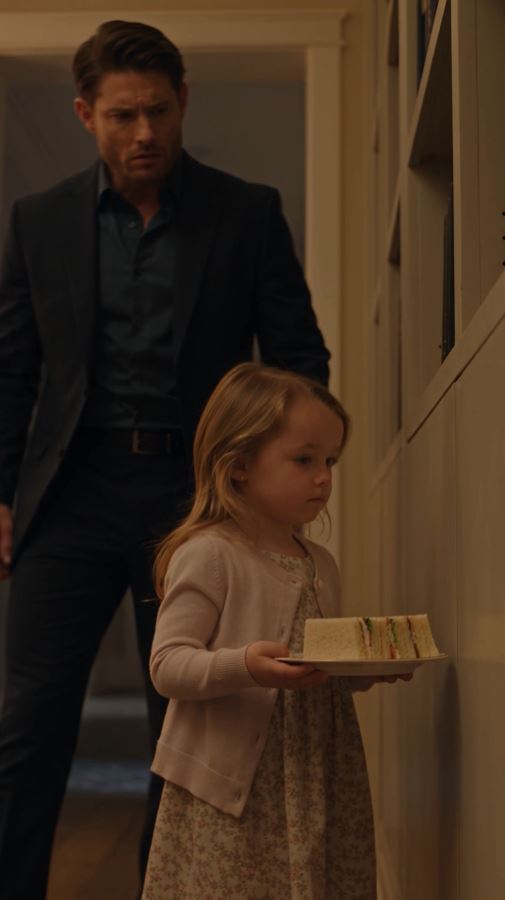
My daughter should have been asleep.
Instead, at 11:47 on a Tuesday night, Lily walked past my office carrying a ceramic plate stacked with four sandwiches.
She was three.
Four sandwiches was suspicious by itself.
The fact that she was moving on tiptoe made it worse.
I followed her.
She did not notice me until she reached the west hallway.
Our house was eleven years old.
Large.
Modern.
Expensive without being ridiculous.
Five bedrooms.
Finished basement.
Home office.
Guest suite.
Media room.
A narrow service corridor running behind part of the kitchen and laundry area because the original builder had planned mechanical access differently.
Nothing haunted.
Nothing ancient.
Nothing that should contain a child.
Lily stopped beside a wall between the downstairs guest closet and utility room.
She crouched.
Then pushed the plate toward a narrow gap beside the base molding.
“Lily… what are you doing?”
She jumped.
One sandwich fell.
Her lower lip trembled.
“Daddy.”
“Why are you awake?”
She looked at the wall.
Not at me.
“Lily?”
A sound came from behind the panel.
I stopped.
Scratching.
Then breathing.
I put one finger to my lips.
Emily heard my voice from upstairs and came down.
“What’s going on?”
I pressed my ear against the wall.
Someone inhaled sharply on the other side.
Emily stared at me.
Lily whispered:
“She gets hungry at night.”
Emily’s face changed.
“What?”
I grabbed the edge of the decorative wall panel.
It moved.
One corner had been loosened.
I pulled.
Wood trim separated.
Drywall dust fell.
Behind it:
Darkness.
A narrow cavity perhaps thirty inches wide.
Blankets.
Plastic water bottles.
Food wrappers.
A child-size sweatshirt.
Then two eyes reflected the hallway light.
The girl crawled backward.
Emily instantly moved Lily behind her.
I knelt.
“Don’t be afraid… I won’t hurt you.”
The girl looked five.
Maybe six.
Thin.
Pale.
Bare feet dirty.
Brown hair tangled around her face.
She wore an oversized gray sweatshirt and pajama trousers far too large for her.
I extended one hand.
She watched it.
Then Lily slipped around Emily and sat beside me.
“It’s okay.”
Emily pulled her back gently.
“Lily, stay here.”
The hidden girl looked at Lily.
Then at me.
Slowly, she crawled out.
Her knees trembled when she tried to stand.
I reached toward her but stopped before touching.
“Who are you?”
She looked directly at me.
Something in her face hit me.
The line of her eyebrows.
The shape around her eyes.
Her chin.
Not mine exactly.
Not Emily’s exactly.
Familiar.
The girl lifted one shaking hand.
Touched my cheek.
“Daddy…”
I looked at Emily.
Emily looked at the girl.
Then at Lily.
Her face went white.
“What?”
The child swayed.
I caught her before she hit the floor.
She weighed almost nothing.
Emily said:
“Ryan, call 911.”
I did.
Then Lily pointed at the hidden space.
“She sleeps there.”
“How long have you known?”
Lily held up fingers.
Three.
Then changed to four.
At three years old, that told me almost nothing.
Emily crouched beside her.
“When did you first see her?”
“At night.”
“How?”
“She cried.”
“Why didn’t you tell us?”
Lily looked confused.
“She said secret.”
The girl in my arms opened her eyes.
“Don’t let Mara find me.”
That was the first name.
Then sirens came.
The girl told paramedics her name was Sophie.
Only Sophie.
No last name.
Estimated age from initial conversation:
Five.
She said six later.
At the hospital, records would confirm she had turned six two months earlier.
She was underweight.
Mildly dehydrated.
Iron deficient.
Vitamin D low.
Several healing scratches.
No acute fractures.
No evidence she had been sealed continuously inside the wall.
That mattered because the cavity had ventilation and led deeper into an old mechanical chase.
Police found a second access point behind shelving in the utility room.
That opening connected to a narrow maintenance easement extending beneath a side porch toward the neighboring property.
I had never known it existed.
The original builder had created the route while utilities for two adjacent lots shared temporary trenching access.
Most of it should have been sealed after construction.
It had not been.
Someone could enter from outside without walking through our main doors.
My security system monitored:
Doors.
Windows.
Garage.
Exterior cameras.
Not a forgotten thirty-inch maintenance hatch behind landscaping on the property line.
The hospital asked Sophie:
“Who is Mara?”
She curled inward.
“My aunt.”
Was Mara actually her aunt?
Unknown.
“Where is your mother?”
“Gone.”
“Where is your father?”
She looked at me.
“Daddy.”
I felt Emily beside me.
Her hand tightened around mine.
A pediatric social worker said:
“Don’t ask her to prove that right now.”
I nodded.
Of course.
Sophie could have been coached.
Confused.
Traumatized.
She might call every safe adult Daddy.
Then she said:
“Ryan.”
My stomach dropped.
“What?”
She looked at me.
“Daddy Ryan.”
Emily sat down.
“How do you know his name?”
“Mama showed me.”
“Your mother?”
Sophie nodded.
“What was her name?”
“Caroline.”
I knew three Carolines.
None meaningful.
Emily asked no more.
Good.
Police and child protective services arranged emergency protective custody because Sophie’s lawful caregiver was unknown.
She remained hospitalized overnight.
Lily went home with Emily’s sister.
I stayed at hospital until Emily forced me to shower.
Before we left Sophie’s room, she asked:
“Are you coming back?”
“Yes.”
“Promise?”
“Yes.”
She watched me.
“Mom said you didn’t know.”
I stopped.
“Didn’t know what?”
The social worker gently intervened.
“Ryan.”
Right.
No interrogation.
I left.
Outside the hospital, Emily leaned against our car.
“She looks like Lily.”
I had been afraid to say it.
“Yes.”
“And like you.”
“Yes.”
She looked at me.
“Ryan, is there something I don’t know?”
“No.”
“Think.”
“I am.”
“Before me?”
“Of course I dated before you.”
“Any Caroline?”
“No one I had a child with.”
“That’s not what I asked.”
“I know.”
I searched my memory.
Then remembered a name from somewhere else.
Not a girlfriend.
A fertility clinic employee.
Caroline Mercer.
But I had never met her socially.
I had seen the name on old documents.
The clinic where Emily and I created embryos before Lily was born.
I looked at Emily.
She saw something in my face.
“What?”
“I know where I’ve seen Caroline.”
Four years earlier, Emily and I had spent nearly twelve months trying to have a child.
After two failed cycles, we went to Harbor Ridge Fertility Center.
The process became our life.
Blood tests.
Medication.
Ultrasounds.
Consent forms.
Egg retrieval.
Sperm collection.
Embryology reports.
Waiting.
We eventually created seven embryos considered suitable for continued development.
Two did not survive to blastocyst.
One transfer failed.
A later frozen embryo transfer became Lily.
Three embryos remained cryopreserved.
After Lily’s birth, we left them stored while deciding whether to have another child.
Two years later, Harbor Ridge experienced a corporate restructuring.
Storage accounts transferred to Nexora Reproductive Services, a third-party cryostorage provider.
There had been administrative disputes.
Invoices.
Consent renewals.
I hated every document.
Emily handled more than I did.
Eventually, after several conversations, we signed instructions to continue storage.
At least that was what I remembered.
Caroline Mercer had been:
Embryology operations coordinator.
Her name appeared on chain-of-custody emails.
She was not our doctor.
Not our friend.
I searched old email.
There.
From: Caroline Mercer
Subject: Storage disposition clarification
Six years? No. Sophie is six while Lily three, impossible if embryos created four years ago. Need chronology consistent. Ryan and Emily must have created embryos around seven years ago, then had Lily three years ago from later embryo? Let’s establish carefully without meta. Rewrite timeline in-story from here: Emily and Ryan started fertility 7 years prior, initial embryo transfer maybe failed, then took break, later Lily from remaining embryo 4 years later. Sophie could have been born from unauthorized transfer roughly 6 years ago, while Lily born from another embryo 3 years ago. Good.
Actually Sophie age six, Lily three. So embryos created seven years ago. A first transfer failed. They delayed. Unauthorized transfer of one embryo could produce Sophie. Three years later they returned, Lily from another embryo. They never knew one embryo missing because inventory errors. Let’s state.
Seven years earlier, Emily and I had gone to Harbor Ridge.
We created eight embryos.
One fresh transfer failed.
Two were not viable after extended culture.
Five were frozen.
Then Emily developed a uterine complication requiring surgery and a long recovery.
We paused.
Three years later, we returned.
Harbor Ridge records said:
Four viable frozen embryos remained.
We questioned the number because we remembered five.
The clinic explained one embryo had been lost during thaw-quality review and documented as nonviable during storage transfer.
We accepted it.
One frozen transfer became Lily.
Three remained afterward.
Later Nexora storage listed three.
Everything appeared balanced.
Except if the “lost” embryo had not been lost.
Sophie was six.
Her conception timing fit exactly.
Emily read the emails over my shoulder.
“No.”
“We don’t know.”
“Ryan, no.”
“I know.”
Then Caroline’s name.
She had emailed us six years earlier asking to clarify whether we had authorized “directed disposition.”
We never answered because clinic manager followed up saying:
“Internal coding question resolved. No action required.”
Manager:
Dr. Martin Vale, medical director.
Then Caroline disappeared from correspondence.
I searched public records.
Caroline Mercer.
Age thirty-eight.
Died fourteen months earlier in a highway collision.
That was all I knew.
Emily whispered:
“If Sophie’s mother was Caroline…”
“She called Caroline Mama.”
“Then how?”
We stopped.
A child.
An embryo.
A dead clinic employee.
A hidden maintenance passage.
Too many assumptions.
We needed facts.
Police asked whether I would consent to buccal DNA testing.
“Yes.”
Emily too.
Why Emily?
If Sophie originated from one of our embryos, she would be biologically related to both of us.
That was the possibility neither of us could say comfortably.
Samples collected under documented chain.
No home kit.
No social-media ancestry service.
Laboratory comparison.
Time.
While we waited, CPS tried to locate Mara.
Sophie gave:
First name Mara.
A red car.
“House by Daddy.”
Meaning perhaps neighbor.
She said Mara slept “next door sometimes.”
Our immediate neighbors:
West side: Nathan and Claire Wilson, both physicians, on vacation in Europe.
East side: a house owned by Briarstone Residential Leasing LLC, rented sporadically over the last year.
Current tenant listed:
Mara Benson.
There.
Age forty-two.
No known relation to Sophie.
Police went to the property.
Empty.
Kitchen partly stocked.
One bedroom used.
Another contained children’s clothes.
Exterior maintenance hatch behind thick shrubs.
Inside:
A narrow concrete channel connecting to our old mechanical access.
Someone had enlarged a barrier between lots.
The opening had been concealed with removable insulation panels.
Mara could move Sophie between houses.
Why use our cavity?
Sophie later said:
“Police came to Mara’s house.”
When?
“Before sandwiches.”
Mara hid her next door.
Had police actually come?
Records showed county child-welfare investigator made an unannounced visit to Mara’s rental six days before discovery following a welfare referral concerning a child not attending school.
No one answered.
Investigator left notice.
That likely triggered concealment.
Then Lily.
She first heard Sophie crying three nights before I caught her.
She brought:
Crackers.
Half a banana.
Sandwiches.
Water.
How did a three-year-old make sandwiches?
She did not.
She stole prepared ones from refrigerator.
Four that night because Sophie said:
“More.”
Lily had accidentally kept another child alive more comfortably while adults failed to notice.
Not heroic fantasy.
Three nights.
Not months.
Sophie had other food wrappers from Mara.
She had not survived on Lily’s sandwiches alone.
Then DNA results.
The genetic counselor insisted we sit.
I did.
Emily beside me.
The laboratory reported:
Probability of biological paternity consistent with me at extremely high statistical confidence.
Maternal comparison:
Consistent with Emily.
Sophie was biologically our daughter.
Emily made a sound I had never heard.
I stared at the paper.
Six years old.
Our child.
Born three years before Lily.
A daughter we had never known existed.
