PART 1: The Night I Stopped Protecting Him
For eight years, I had left one important truth about my family unspoken around my husband’s relatives. To the Caldwells, my father was a quiet, retired sailor spending his later years near the Virginia Beach coast. They knew nothing about his service as a Navy SEAL, the men he had commanded, or the unsettling composure he possessed when everything around him fell apart. I had never explained any of it. They remained comfortably unaware until the afternoon my husband hit me hard enough to send a piece of my front tooth across his mother’s spotless kitchen floor.
My name is Rachel Mercer. I was thirty-six when my eight-year marriage to Evan Caldwell finally began to come apart. It happened on a Saturday in late October, during what should have been an ordinary visit to his parents’ large Chesapeake home. Diane Caldwell’s pot roast scented the kitchen, while a college football broadcast murmured from the den where Richard sat in his recliner. I was cutting carrots at the granite island when Evan appeared beside me, his jaw clenched. He demanded an explanation for three thousand dollars supposedly transferred from our joint account. “I didn’t move anything, Evan,” I murmured, still looking at the cutting board. He leaned closer. “Yes. You did.” “No, I really didn’t.” Behind us, Diane’s spoon stopped scraping against her gravy pot.
I dried my hands on a dish towel and faced him. “Show me the transaction.” He pulled out his phone without unlocking it, his eyes narrowing. “Why do you always insist on making everything a massive ordeal?” I knew that note in his voice. For years, I had responded by making myself smaller, apologizing before I understood the accusation, changing subjects before his anger could gather momentum. But that afternoon, exhaustion rose above fear. I no longer had the strength to manage his temper for him. “Open the banking app, Evan,” I said evenly. “Show me exactly where I moved our money.” Diane answered with an exaggerated sigh. “Oh, for heaven’s sake, Rachel. Evan works grueling hours. He doesn’t need to be interrogated in his own childhood home.”
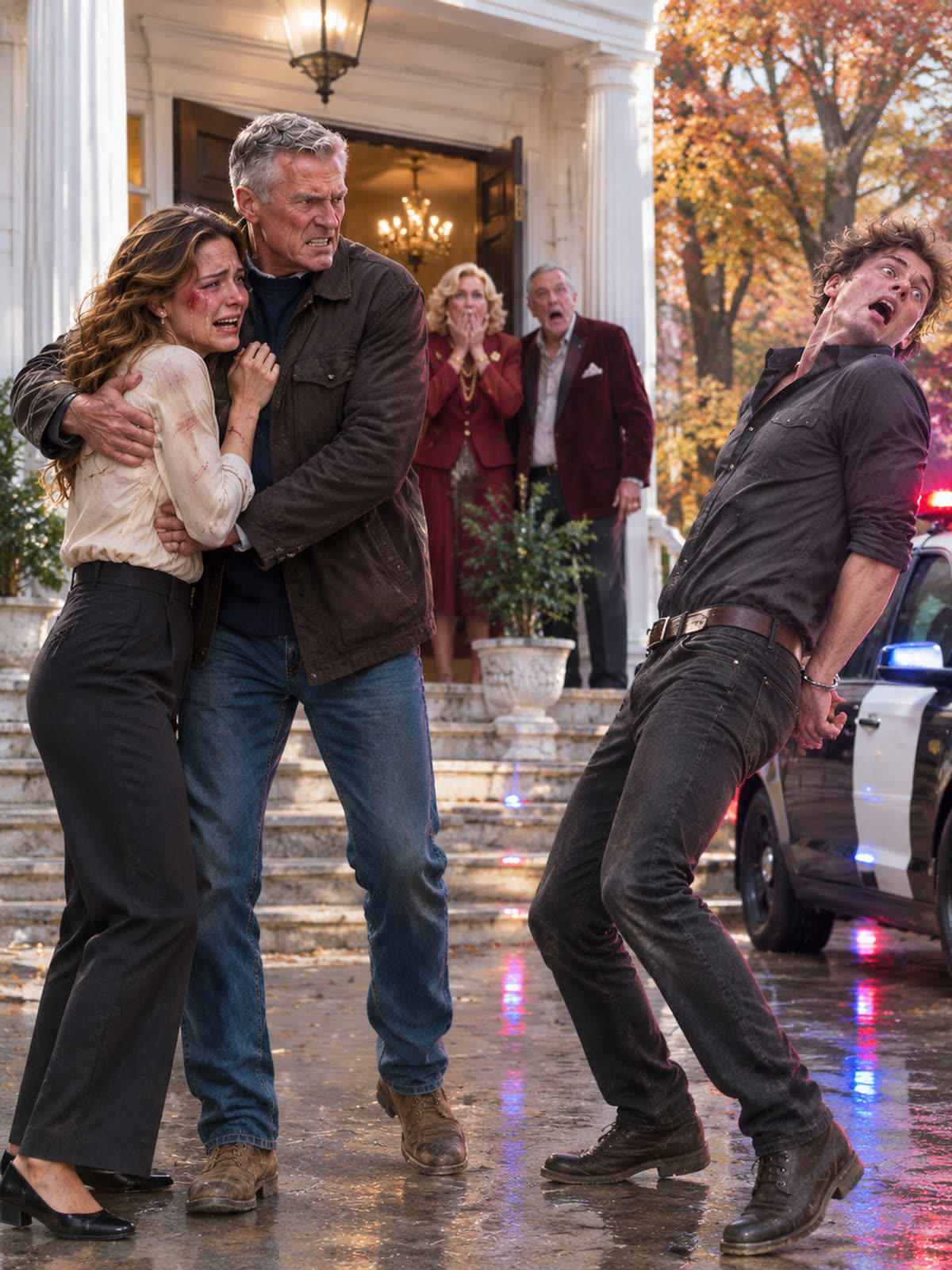
I looked directly at her. “I’m not interrogating anyone, Diane. He just accused me of draining three thousand dollars.” Evan moved so close that his chest nearly touched my shoulder. “Drop it.” “No.” That single word was enough. His hand struck my face before I could register the movement. The crack seemed to fill the kitchen. I stumbled sideways, catching my hip against the granite, and heard something hard tap against the tile. A piercing whine filled my left ear. When I touched my mouth, my fingers came away bloody. Near my shoe lay a sharp white fragment of my tooth. For a moment, Evan looked astonished by what he had done. Then his expression hardened. “You pushed me way too far,” he hissed.
The speed of his justification hurt in a way I could not immediately name. Diane hurried toward us, and for one foolish heartbeat I thought she meant to help me. Instead, she caught her son’s arm and searched his face. “Are you okay, sweetheart?” I stood beside them tasting blood, scarcely able to believe what I was hearing. Finally, she turned toward me. “Don’t you dare start crying, Rachel. You’ve been provoking him since you walked through the front door.” Richard appeared in the doorway, shifted awkwardly, and looked away. He offered no protest, no question, not even a word of concern. His silence made it clear how alone I was in that kitchen.
I reached for my phone, but Evan took it before I could make a call. “Who exactly do you think you’re calling?” “Give it back to me, Evan.” Diane lifted it from his hand. “You want somebody to come rescue you? Fine.” She still remembered my passcode from a road trip years earlier. She opened my contacts with brisk, satisfied taps. “Let’s call him.” Dread tightened inside me. “Diane, do not do this,” I warned. She gave me a small, triumphant smile, set the phone on the island, and switched on the speaker. My father answered after three rings. “Hey, sweetheart.” Diane bent toward the microphone. “Mr. Mercer, this is Diane Caldwell. Come take your useless daughter home.”
The silence from the phone seemed to settle over the entire room. Then Dad asked, without a trace of warmth, “Where is Rachel?” “She’s right here, sulking,” Diane replied. My throat tightened. “Dad…” His voice changed immediately, becoming frighteningly calm. “Are you hurt, Rachel?” Before I could answer, Diane laughed dismissively. “Oh, please, spare me the drama. Evan barely laid a hand on her.” Another silence followed. I recognized it. My father did not waste words when something serious was happening. The Caldwells mistook that restraint for weakness because they had never seen what lay beneath it.
“What happened?” Dad asked. I looked straight at Evan. “He hit me.” Dad asked only one more question. “Are you bleeding?” “Yes.” His voice never grew louder. It simply became harder. “If my daughter has so much as a single scratch on her when I arrive… your entire family will regret it.” Diane rolled her eyes and ended the call. Evan gave a short laugh. “What’s your old man going to do, Rachel?” I said nothing. Dad was sixty-seven, with salt-and-pepper hair, a troublesome left knee, and a battered silver pickup. He usually wore faded navy sweatshirts. Nothing about him advertised the life he had led, and they had decided that meant there was nothing to fear.
Three minutes later, the phone vibrated in Diane’s hand. She glanced at the caller’s name and dropped it onto the counter. I snatched it up and hurried to the downstairs powder room. Evan’s footsteps followed me along the hallway. I shut the heavy oak door and turned the brass lock before answering. “Dad?” “Listen to me very carefully, Rachel. Is the door secured?” “Yes.” “Good. Take pictures of your face immediately. The mouth, the swelling, everything. Do not wash anything away yet.” My hands shook so badly I could hardly hold the phone. “Dad…” He brought me back to his voice. “Rachel, focus on my voice. Photograph whatever you safely can. Save any text messages Evan has sent you recently. And then, you dial 911.”
I pressed my forehead against the cool door and finally understood what he was doing. He was not racing toward Chesapeake to beat my husband bloody. He was making sure I survived long enough to stop concealing what Evan had become. I lifted the phone and tried to photograph my face. The first pictures blurred, so I made myself breathe, steadied my hands, and tried again. I captured the swelling across my cheek, the split in my lip, and the broken edge of my front tooth. Seeing the injuries on a screen made them impossible to explain away. Once the photographs were saved, I opened the keypad and entered the three numbers I had spent eight years believing I would never need.

Evan began pounding on the door. “Rachel! Open this door right now!” Behind him, I could hear Diane urging him to lower his voice. It was not my safety that worried her; it was the possibility of a scene. “911, what is the address of your emergency?” the dispatcher asked. I drew a trembling breath and gave her the truth without softening it. No excuses about stress. No careful account designed to spare Evan embarrassment. By the time she told me officers were coming, the pounding had stopped. The quiet beyond the door frightened me more than the noise. “Are there any weapons in the residence, ma’am?” I told her about Richard’s locked gun safe upstairs, although I did not believe anyone had opened it. “Stay exactly where you are if you feel secure,” she instructed.
I sat on the closed toilet lid and held a guest towel to my mouth. In the ornate mirror, my face looked unfamiliar, the cheek already turning red and purple. My tongue found the rough edge of the damaged tooth, and suddenly I was remembering my father’s kitchen from childhood. His military years had always seemed both mysterious and ordinary. There were old plaques in his study and occasional visits from soft-spoken men with watchful eyes. They used abbreviations I did not understand, but Dad never encouraged questions about his accomplishments. He disliked the swagger other people attached to that part of his life. To him, it was work he had done, not a performance he needed to repeat.
Once, as a teenager, I had watched him wash a coffee mug and asked, “Why don’t you ever tell people what you actually did?” “Because I’m retired, Rach. That chapter is closed.” I had refused to let it go. “But you spent years doing things most people would be terrified to even watch!” He set the mug on the rack and dried his hands. “And today, my biggest mission is remembering to buy two-percent milk.” That was how he lived. He taught me to change a tire in the rain, hide emergency money in a suitcase lining, and notice when the atmosphere in a room shifted. His lessons were practical, quiet, and intended to keep me safe when he could not be beside me.
After a fight with a middle-school bully, he had sat me down and held my gaze. “Anybody can lose their temper, Rachel,” he said. “Never confuse losing control with being strong.” In the Caldwells’ bathroom, those words broke my heart. I had spent years treating Evan’s anger as if it were evidence of powerful feeling rather than a warning. During our courtship, his intensity had seemed romantic. He drove through storms when my car failed and brought soup when I was sick. Dad had noticed other things. At our third Thanksgiving together, Evan kept interrupting me, correcting my recollections and finishing my sentences. Later, Dad asked, “Does he always feel the need to narrate your life for you?” I had defended my fiancé. “Dad, please don’t psychoanalyze him.”
My father had respected that boundary. He had warned me, then allowed me to make my own choice. At first, marriage seemed to justify my confidence. The changes came gradually. Losing my keys made me “chronically incompetent.” Disagreeing with Evan’s politics made me “hysterical.” Then came the blocked doorways, the fingers tight around my wrist, the mug smashing against the wall beside my head. Each time, I reassured myself that he had never actually hit me. I treated the absence of a direct blow as proof that my marriage remained acceptable. Diane reinforced that belief. She described marriage as an ordeal women endured and Evan’s temper as the same passionate nature his father possessed. I had listened because accepting her explanation was easier than facing my own fear.
My phone vibrated in my lap. Dad wanted to know whether the police were coming. I answered yes, and his reply told me to remain behind the locked door. He was on his way. There was no dramatic vow, only the steady assurance that he was coming. I sent the photographs to a separate, secure email account Evan did not know about. Then I searched my archived messages, as Dad had instructed. The threats were there in ordinary black letters: demands to know where I was, warnings to be home before him, promises to come looking for me. I had lived among those messages so long that I had stopped recognizing what they meant.
Whispers drifted through the door. “She’s blowing this completely out of proportion to punish you,” Diane hissed. “Just let her cool off,” Evan answered. “She’ll calm down.” My stomach dropped. He still believed he understood how this would end. I would cry, he would apologize, and Diane would make tea while explaining the compromises marriage required. Richard would insist that private problems remain private. Eventually, I would sit beside Evan in the car and go home. Their certainty was almost more horrifying than the slap. They had all participated in this pattern for so long that none of them imagined I might refuse my assigned place in it.
A quiet knock interrupted my thoughts. “Rachel?” Evan sounded wounded now, almost gentle. “Come on, baby. I’m so sorry.” I did not answer. “It was an accident. I just reacted. You know I would never intentionally hurt you.” I looked at my reflection, at the swelling and the towel stained from my mouth. His voice acquired a faint, accusing edge. “Are you seriously going to call the cops on your own husband over a mistake?” Something inside me became very still. I stood, turned the lock, and opened the door, keeping myself within the bathroom doorway.
He waited a few feet away with his hands tucked into his pockets, arranged into a picture of harmless regret. Diane stood just behind him. I looked at the man I had slept beside for almost three thousand nights. “You forfeited the title of my husband the second your hand struck my face.” His expression emptied. For an instant, there was no apology left to hide behind, only the shock of hearing me speak without trying to soothe him. Then a sound rose outside, faint at first and quickly unmistakable: sirens approaching through the quiet neighborhood.
Diane turned toward the front windows. Red and blue reflections moved across the glass, and her confidence vanished. Evan stepped backward. The panic on his face was real this time. “Rachel… what did you do?” he whispered. For once, I was not most frightened by his anger. I was frightened by how many years I had sacrificed protecting him from its consequences. An authoritative knock sounded at the front door. The familiar ending they had counted on was gone, and none of us yet knew what would take its place.
PART 2: The Consequences He Never Expected
The moment the front door opened, the house ceased to feel like the setting of an ugly family argument. Officer Ramirez, a stern-faced woman who took charge immediately, saw my injuries before Evan could explain them away. “Ma’am, I need you to step outside with me right now,” she said. Her decisiveness felt like someone cutting a rope that had kept me tethered to him. A male officer stayed in the foyer with Evan while she led me onto the broad front porch. Cold October air touched my swollen cheek. “Walk me through exactly what happened,” she said, readying her pen. This time, I gave the sequence plainly: the accusation about money, my request to see the transaction, the slap, the counter, and my tooth on the floor.
“Did he strike you with an open palm or a closed fist?” Ramirez asked. “Open hand.” “Is this the first time he has laid hands on you?” The old reflex stirred immediately. Part of me still wanted to distinguish this incident from everything that had come before, as though the earlier bruises and trapped arguments belonged in another category. “Not exactly like this,” I whispered. She stopped writing. “That was not my question, Rachel.” I swallowed. “He’s grabbed me. Hard. He’s physically blocked me from leaving rooms during arguments. He throws things at the walls near my head.” She recorded it without surprise or judgment, and that steadiness helped me continue.
Another police unit arrived. A technician photographed my face, the blood on my collar, and the broken tooth. Inside, officers documented the kitchen and collected the fragment from the floor. Through an open window, I heard Diane trying to make the violence sound small. “They were just bickering, Officer,” she said. “My son just lost his temper for a split second. One second of poor judgment.” Her explanation assumed that something done quickly could not be very serious. The paramedics found no major concussion but urged emergency dental treatment. While I signed the paperwork declining transport, Evan’s voice reached the porch. “It was just a slap! She was screaming at me! She embarrassed me in front of my own parents!”
The more he spoke, the clearer the situation became. Eventually, the door opened and the male officer brought him outside with his hands cuffed behind his back. Diane hurried after them. “You can’t be arresting him! This is a misunderstanding!” The officer continued toward the cruiser. She turned on me, frantic now. “Rachel, tell them you don’t want to press charges! Tell them to stop!” Less than an hour earlier, she had watched me bleed and called me useless. Now she wanted me to rescue her son. “You can fix this, Rachel!” “No, Diane,” I answered. “Evan could have fixed this by keeping his hands to himself.” She drew back as though the words had physically struck her.
I was still shivering on the porch when familiar headlights turned onto the street. Dad’s battered silver Ford stopped beside the curb. In my imagination, some younger part of me had always pictured him arriving in tactical gear, frightening everyone into submission. The real man climbed out in faded jeans, worn work boots, and a dark canvas jacket. His bad knee made his movements slightly stiff. Somehow, seeing him exactly as he always was affected me more deeply than any dramatic entrance could have. Evan noticed him from beside the cruiser and scoffed. “Oh, great. Here he is,” he muttered. Dad did not look his way.
He crossed straight to the porch, his attention fixed on me. Under the light, he could see every mark clearly. He stopped, his gaze moving from my swollen cheek to my split lip and damaged tooth. His jaw tightened so hard that, for one alarming instant, I glimpsed something terrible behind his restraint. Then his expression changed, and he was simply my father again. “Did you give the officers the complete truth?” he asked. “Yes. Everything.” I made myself hold his eyes. “The grabbing, too. The thrown objects. The doors.” He nodded once. “Good.” Then his hand settled on my shoulder, warm and steady. “Let’s get you a dentist.”
There was no shouting, no challenge across the lawn. When Ramirez introduced herself, he shook her hand and asked careful questions about protective orders and retrieving my belongings. The absence of a confrontation appeared to disturb Evan more than an angry outburst would have. “What, you going to threaten me to my face now, old man?” he called from the cruiser. Dad turned his head and looked at him for the first time. Handcuffed outside his parents’ house, stripped of the audience that normally protected him, Evan seemed suddenly smaller. Dad said nothing. Diane hurried down the steps. “Evan, shut your mouth!” she hissed.
Evan could not tolerate being dismissed. “What were you going to do, Mercer? Drive down here and beat me up? Act like a tough guy?” Richard had come onto the porch. He studied Dad with a new uncertainty. “Tom? Right? You were Navy.” Dad gave a short nod. “Twenty-four years.” “What unit?” Richard asked. Dad answered matter-of-factly, identifying his SEAL team and explaining his deployment history without embellishment. He did not use it to impress them. It was simply the answer to a question. But the effect on the Caldwells was immediate. Their assumptions about the harmless retired sailor had collapsed, and they had nothing ready to replace them.
Evan’s sneer faded. “So…” he stammered. “That was a threat on the phone.” Dad shook his head. “You completely misunderstood me, son. I wasn’t threatening your family. I was making a promise that hurting my daughter would yield severe consequences. The police are the consequences.” Then he turned away, ending the exchange. He looked at me instead. “Ready?” “I am.” With an officer beside me, I went inside and packed an overnight duffel: clean clothes, a toothbrush, my laptop, and chargers. Those ordinary objects felt strangely weightless beside what I was leaving behind. I was too numb to understand how much of my life had just changed.
When I returned to the porch, Dad took the bag. Only then did I fold against him, pressing my face into his canvas jacket. He held me tightly without putting pressure on my injuries. In the truck, the Caldwell house glowed behind us, its welcoming windows concealing everything that had happened inside. Dad started the engine but kept his foot on the brake. “Rachel… do you want to go back in there?” I stared ahead, remembering eight years of holidays, private jokes, apologies, and the gradual disappearance of my confidence. I heard Evan blaming me and Diane demanding that I repair what he had done. “No,” I whispered. “No, I don’t.” Dad pulled away from the curb.
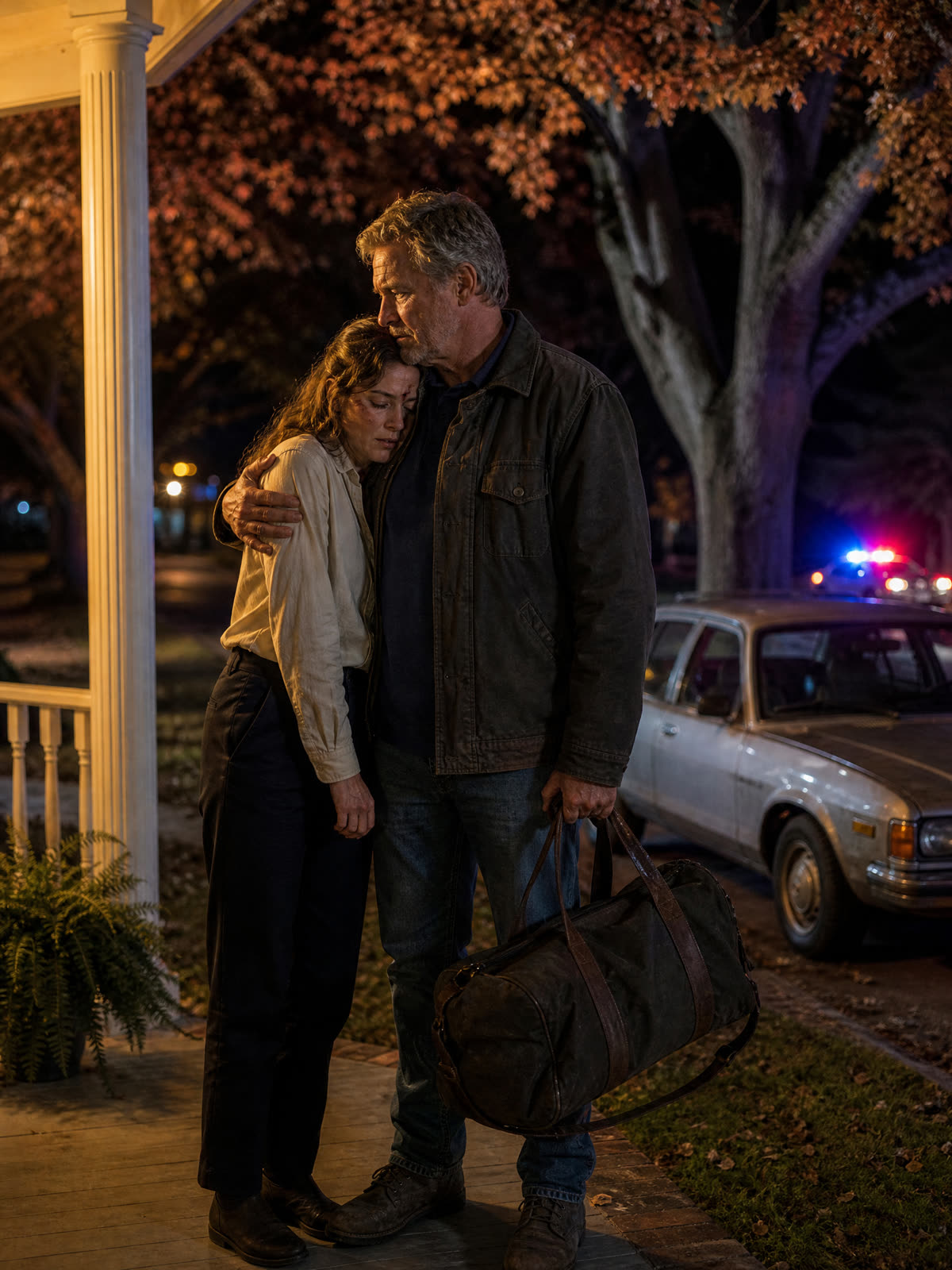
As the house disappeared behind us, I understood that the most frightening part was not only what had happened in the kitchen. It was that I had spent eight years forgetting I was allowed to leave. Yet escaping the house did not end the damage. The following dawn brought a quieter kind of pain. I woke in my childhood bedroom, surrounded by familiar pale blue walls and the old brass lamp on my desk. The room seemed unchanged, but I was not the woman who had once lived there. The emergency dentist had temporarily capped my tooth. My jaw still ached, and when I touched my cheek, the swelling made everything from the previous night real again.
Downstairs, Dad was making coffee. He slid a mug toward me as I stood at the island in my socks. “I have to figure out how to untangle my entire life,” I whispered. He sat across from me. “Okay.” I waited for instructions, for a furious declaration that I must divorce Evan and destroy him in court. None came. “Aren’t you going to tell me what to do?” I asked. “Aren’t you going to tell me to divorce him?” “No.” His answer frustrated me. “Why the hell not?” Dad put down his coffee. “Because, Rachel, if I sit here and dictate your future, I am just performing another version of what Evan did to you. I will protect you. I will help you lay out the map. But you are the one who has to choose the destination.”
I cried then, quietly, tears falling onto the counter. That Monday, I went to see Laura Whitaker, a family-law attorney in Virginia Beach. Her office was polished and imposing, but she did not offer the kind of revenge I might once have imagined wanting. She offered a careful way out. That was why I chose her. “We need total financial transparency,” she said, moving a legal pad toward me. “I want bank statements, tax returns, investments, hidden assets. Everything.” The work sounded exhausting, but it also gave shape to a future that had seemed impossible to untangle. Instead of trying to understand my whole marriage at once, I could begin with a statement, a date, a number.
That weekend, Dad’s dining room disappeared beneath paperwork and open devices. We worked through old records, and I started with the three thousand dollars Evan had accused me of taking. When I signed into our joint checking account, I found the transfer immediately. The money had left our account, but it had not gone to me. It had gone to an outside account ending in 4417. “Dad,” I said, feeling the blood leave my face. “Look at this.” He leaned over my shoulder. I did not recognize the destination account. Searching backward, I found five hundred dollars sent six weeks earlier, two thousand before that, and another transfer of seven hundred fifty dollars.
The withdrawals had been spaced and sized so they could pass unnoticed among ordinary household expenses. I had not examined them closely because I had trusted my husband. Now each entry seemed to reveal another place where that trust had been used against me. “How long has he been plotting this?” I asked, sickened. Dad did not let me drift into guesses. “Don’t speculate,” he said. “Document what you can prove.” We kept working. By midnight, we had traced ten months of transfers, thousands of dollars quietly moved into an account I had never known existed. The accusation in Diane’s kitchen had not merely been false. It had come from the person responsible for the missing money.
Then I remembered an old iPad connected to our shared Apple account, a device Evan seldom touched anymore. I synchronized the messages and began reading conversations between him and Diane. My hands shook as I moved through the exchanges. In March, she had told him to begin protecting his assets in case I decided to leave. He had reassured her that he was handling it and had another account I could not see. I sat beneath the dining-room light with tears running down my face. The slap had happened in an instant. This betrayal had required planning, repeated decisions, and his mother’s cooperation.
While I had been cooking meals, washing clothes, and trying to understand why I could never keep him satisfied, he had been arranging a private financial escape. Diane had helped him prepare to leave me with less, even while teaching me that a good wife endured. The violence no longer looked like an isolated moment when his temper escaped him. It belonged to a much longer pattern of contempt. I could not stop thinking about how ordinary our days had seemed while those conversations were happening behind my back. Dad remained beside me, helping preserve what we found rather than letting either of us become lost in speculation.
For the next ten days, Evan’s voicemails changed tone with bewildering speed. On Monday, he was angry: “You’ve punished me enough, Rachel. Come home.” By Wednesday, he was crying. “I am so broken without you. I’m starting therapy. Please, baby.” On Friday, he threatened instead. “You are literally destroying two families over one mistake. You have no idea what kind of hell you’re inviting.” Laura advised me to keep the messages. Dad did not insist that I block him. I let the recordings accumulate and documented them, turning the demands and emotional reversals into a record instead of allowing them to dictate my next move.
Then Diane sent a message accusing me of trying to take Evan’s money even after everything he had done to keep me from bankrupting him in a divorce. She told me to have dignity and walk away. I read it again, and a slow smile crossed my bruised face. For once, her determination to defend him had exposed exactly what they wanted hidden. I sent Laura a screenshot. “She just confirmed he was hiding assets,” she said over the phone. “She just handed us the intent on a silver platter.” We sought the records for account 4417. The more documentation emerged, the harder it became for Evan to maintain his version of events.
But evidence did not make him calmer. As the legal pressure increased, so did his desperation. When the day arrived for the preliminary hearings on financial injunctions and protective orders, Dad drove me to court and walked beside me without crowding me. I tried to concentrate on that steady presence rather than imagine every possible encounter. We stepped from the elevator into a marble corridor. Near the courtroom doors, Evan was waiting. His face held none of the remorse he had performed in his messages. He saw me, and his posture changed.
He started directly toward us, fists clenched, ignoring his attorney’s urgent attempts to call him back. The sound of his shoes carried along the corridor. My body recognized his anger before I could think; my breath caught, and the remembered sting of his hand flashed across my cheek. He was closing the distance quickly. After the hidden money, the arrest, and the unraveling of his control, one thought took hold with terrifying clarity: Evan looked like a man who believed he had nothing left to lose.
PART 3: The Apology I Never Expected
I stepped backward before I could stop myself. Dad did not square up or lift his hands. He simply moved between us, placing his body in Evan’s path. Evan halted, breathing hard, his anger sharpened by desperation. “Are you happy now, Tom? You finally got what you wanted. You finally poisoned her against me.” Dad’s face remained still. “This has absolutely nothing to do with me.” “Bullshit!” Evan’s voice rang against the marble. “You’ve been waiting eight years to ruin my life because you never thought I was good enough for her!” The old instinct urged me to intervene, to smooth the edges before someone became angrier. I stayed where I was.
“You’re right about one thing,” Dad answered quietly. “I never thought you were good enough. But my opinion didn’t matter. She chose you. And you repaid that choice by striking her across the face.” Evan looked past him toward me. “It was one mistake!” he pleaded. “I apologized, Rachel! I said I was sorry!” He used the familiar expression that had so often persuaded me to put his distress ahead of my own. This time, I could see the demand beneath it. He wanted his apology to cancel my right to leave. He wanted me to treat regret, or the appearance of it, as payment for everything he had done.
Dad did not shout. “She heard your apology, Evan. And she gets to decide whether your apology is worth a damn. I spent my entire life teaching my daughter that no man gets to dictate her worth. I regret that somewhere along the line, she forgot that lesson. But she remembers it now.” Evan stared at him, then searched my face for the wife who would compromise simply to end the confrontation. I held his gaze. I was not crying, and I was not moving toward him. At last, he turned and went back to his attorney. His retreat did not feel triumphant. It felt like room becoming available for me to breathe.
Inside the courtroom, everything happened with far less drama. Laura presented the transfer records and Diane’s revealing message. The judge ordered the hidden accounts frozen and a complete forensic audit. There was no speech that could return eight years to me, no ruling capable of repairing every part of what had happened. Still, the documents had been heard, and Evan could no longer keep those finances beyond examination. Outside afterward, I stopped on the courthouse steps. “Dad,” I said, looking down. “What you said in there… about me forgetting my worth.” His expression softened. “I shouldn’t have spoken for you.”
“No,” I said, my throat tightening. “You were right. For weeks, I’ve been consumed with rage toward Evan and Diane. But today, I realized the person I’m most furious with is myself. I let him shrink me. I forgot who I was.” Dad moved down a step until we were looking at each other at the same height. He did not try to explain away my feelings or bury them beneath easy reassurance. “Then never forget again.” Those words stayed with me as the weeks passed. They did not make healing immediate. They gave me something to return to whenever Evan’s old judgments began sounding like my own thoughts.
Four months later, I rented a modest apartment on the second floor of a building overlooking oak trees. It was drafty and mostly unfurnished. On the first evening, I ate inexpensive takeout while sitting on the bare floor, and I felt richer than I ever had in the Caldwell family’s comfortable rooms. Nobody’s mood determined whether I could enjoy the quiet. The divorce continued through negotiations and paperwork, but my life had begun moving separately from it. The bruises disappeared. My dental implant looked perfect. The nightmares became less frequent, and the silence around me stopped feeling like a warning. It belonged to me now.
Then, on an ordinary Tuesday afternoon, Diane’s name appeared on my phone. She acknowledged that she had no right to ask anything of me and requested a meeting over coffee. She said she owed me a profound apology. I stared at the message until the words blurred. This was the woman who had called my father to humiliate me, protected Evan while I bled, and encouraged him to hide our money. Part of me wanted to dismiss the request immediately. Another part wanted to hear what she could possibly say without her son standing beside her.
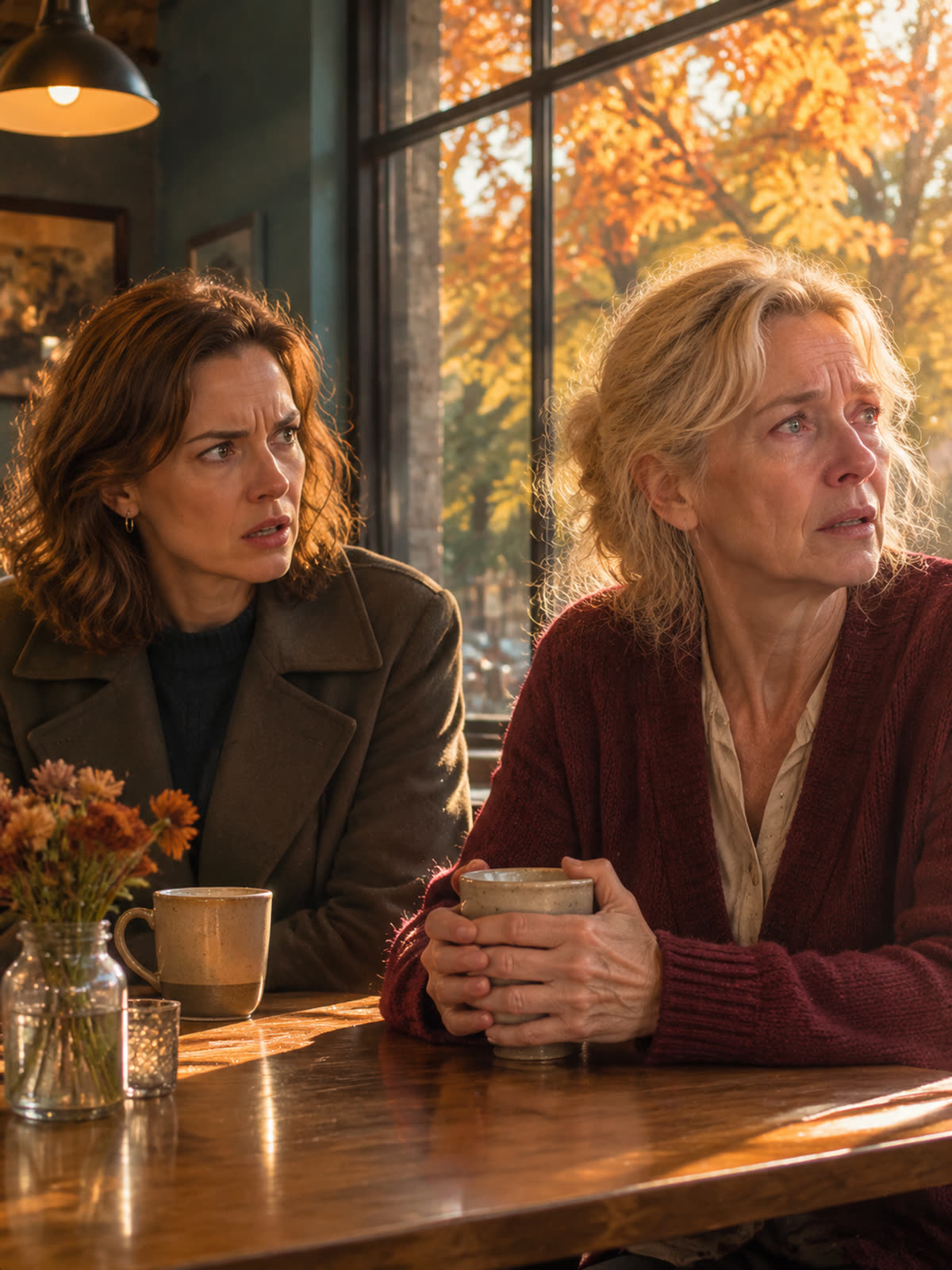
That weekend, while Dad was repairing a kitchen-cabinet hinge, I showed him the message. He wiped his hands and returned the phone. “What do you think I should do?” I asked, feeling my anxiety rise. “I think you need to decide if hearing her out serves your healing, or if it just reopens the wound,” he replied. He did not choose for me. The following Saturday, I went to a busy local café. My heart was pounding before I saw Diane in a corner booth. She looked nothing like the carefully polished woman who had ruled that kitchen. Her hair was unstyled, her face bare of its usual elaborate makeup. She seemed frail.
I sat opposite her without removing my coat. “Diane.” Her hands trembled around her mug. “Thank you for coming, Rachel. I… I’ve rehearsed this speech a hundred times.” “Then skip the script,” I said. She flinched and nodded. “What Evan did to you was monstrous. And what I did… how I treated you… was unforgivable.” Tears gathered in her eyes. “I saw your face that night. I saw the blood on your chin. And God forgive me, the very first thing I felt was the desperate need to protect my son from the consequences.” Hearing her admit it did not soften the memory. It brought back the kitchen with painful clarity.
“Why?” I asked, anger rising. “Why was your instinct to crush me?” Diane looked toward the window. When she spoke again, her voice was almost a whisper. “Because when Richard and I were first married… he had a terrifying temper.” I sat motionless, stunned by the admission. The man who had stood silently in the kitchen had not merely chosen to ignore his son’s behavior. There was a history beneath that silence, one I had never been told. Diane’s fingers remained tight around the mug as she gathered herself to continue.
“He never hit my face,” she said. “But he destroyed furniture. He punched holes in the drywall. Once, he grabbed my upper arms so hard he left deep, black bruises for weeks. My mother told me that this was simply the burden of marriage. That women had to learn how to navigate the storms without provoking the thunder.” The explanation echoed too much of what she had once told me. I could hear the same lesson being handed from one woman to another, dressed as wisdom when it was really an instruction to endure. Her voice trembled, but I did not interrupt. I needed to hear the rest.
She turned back from the window. “I stayed. Richard mellowed out as he aged. We built a beautiful, wealthy life on top of a foundation of silence. But Evan grew up watching that dynamic. He learned that rage was a tool, and that apologies erased the damage. When he started showing those same signs as a teenager, breaking things, screaming at girlfriends… I covered it up. Because admitting that Evan was abusive meant admitting that I had sacrificed my own dignity to raise him.” I stared at her across the table. The pattern I had lived inside had begun long before I entered their family, and she had helped preserve it.
“When he hit you,” Diane continued, crying softly, “and you refused to stay quiet, you shattered the illusion I had spent thirty years maintaining. I attacked you because you had the courage to do what I never did.” For the first time, I understood something about the cruelty she had directed at me. My refusal had threatened the story she needed to tell about her own life. That knowledge did not erase her choices. It did not return the money, silence the insults, or change the moment she had checked whether Evan was all right while I stood bleeding beside him. Understanding was not the same as absolution.
“I am so incredibly sorry, Rachel,” she said. I drew a slow breath. The anger did not disappear, but I no longer felt compelled to hold it in the same clenched place inside me. “I hear your apology, Diane. And I accept it. But this doesn’t mean we are family again. I forgive you, but I never want to see you again.” She nodded, her mouth trembling into a sad smile. “I know. I just needed you to know it wasn’t your fault.” There was nothing else I needed to promise her. Accepting an apology did not require reopening my life to the person offering it.
When I left the café, I felt lighter than I had in years. I had listened without surrendering my boundary. Diane’s grief had not become another obligation I had to carry, and her explanation had not drawn me back into the family’s old arrangement. The Caldwells no longer seemed to occupy every corner of my thoughts. I could understand more of what had happened without returning to it. For the first time, I began to believe their hold on me might finally be weakening. The divorce was close to completion, and the small apartment above the oak trees was becoming a place where I could imagine a life beyond them.
Two weeks later, I opened my mailbox and found a clean white envelope. My name was written across the front in Evan’s sharp, unmistakable handwriting. My heart tightened immediately. After the calls, the accusations, and the confrontation at court, I could not imagine what he believed remained to be said. I stood looking at the envelope, aware of how quickly an ordinary afternoon had changed. The divorce was nearly over. I had begun to trust that the space between us would keep growing. Yet there he was again, reduced to handwriting on paper and still able to make my hands shake.
I carried the letter upstairs and sat at my small kitchen table. For a moment, I only looked at it. Then I took the letter opener and slit the envelope. I expected another attempt to make me responsible for his pain, another plea disguised as love, or another accusation meant to frighten me back into silence. I unfolded the heavy sheet and braced myself. But when I read the first sentence, a chill moved through me. Whatever I had expected Evan to write, it was not this—and suddenly, everything I thought I understood about the end of our marriage shifted.
The letter opened with words I had desperately wanted to hear for eight years, words I had never imagined Evan would possess the humility to put on paper.
Rachel, I am not writing this letter to ask you to come back to me.
I blinked and read the opening sentence a second time, making certain I hadn’t misunderstood it. Drawing a slow breath to steady myself, I continued reading. I kept expecting the familiar qualification to appear, the inevitable *but* that had accompanied every apology throughout our marriage. *I’m sorry, but you pushed me. I was wrong, but you were difficult.*
Yet that familiar excuse never came.
I hit you, the letter read in stark, undeniable black ink. There is no context, no excuse, and no amount of provocation that makes that less true. It was a choice I made, and it was abhorrent.
Evan went on to describe how the anger management program ordered by the court had eventually led him into intensive individual counseling. He explained the painful, humiliating work of examining his own behavior and stripping away the arrogance that had shaped his identity.
For as long as he could remember, he had regarded his anger as something outside his control, almost like a separate force unleashed by the failures of everyone around him. Whenever he shouted, he convinced himself it was because someone had refused to listen. Whenever he resorted to physical aggression, he justified it by claiming another person had pushed him beyond his limits.
My mother spent my entire life shielding me from the consequences of my actions, and I eagerly let her, Evan wrote, his handwriting jagged with emotion. But I am a thirty-nine-year-old man. I can no longer blame my parents for the monster I chose to become when things didn’t go my way.
I remained seated in the stillness of my apartment, holding the letter and staring at the words.
I had imagined this moment countless times. There had been nights when I cried myself to sleep, prayed for some impossible breakthrough, and begged the universe to make Evan understand just how deeply his cruelty had wounded me.
Now, finally, he appeared to understand.
And as I sat there absorbing his confession, an unexpected realization settled quietly over me.
His newfound awareness changed absolutely nothing.
His apology was sincere. The remorse behind it seemed authentic. He had genuinely begun confronting the person he had been.
But none of that could undo what had happened.
I felt no desire to pick up my phone. I didn’t want to hear his voice, break down in tears, or discuss the possibility of rebuilding our marriage. Whatever emotional connection had once kept me tied to him was gone.
The bond had been severed beyond repair.
One week later, I wrote a brief email consisting of only two sentences and sent it to his attorney with instructions to forward it.
I read your letter, and I truly hope you continue to do the heavy lifting in therapy. But our marriage is over, and this is my final communication with you.
Several hours afterward, a response arrived containing just one word.
Understood.
When the judge finally brought down the gavel, legally ending our marriage and restoring my name from Rachel Caldwell to Rachel Mercer, I felt no urge to celebrate extravagantly.
There was no expensive champagne waiting to be opened, no gathering of friends, and no elaborate divorce party.
Instead, I drove directly to my modest apartment, changed into the oldest and most comfortable sweatpants I owned, warmed a bowl of leftover lentil soup, and called my father.
“It’s done,” I said, gazing through the window at the oak leaves moving in the breeze.
“How is your heart holding up?” Dad asked, his familiar voice surrounding me with warmth and reassurance.
“I think… I think I’m actually okay. Better than okay.”
“Do you want me to come over? Bring some terrible takeout?”
A smile spread across my face, genuine and completely free of the anxiety that had once accompanied every expression of happiness.
“No. I’m going to enjoy the quiet tonight. But I’ll come to your place for coffee on Sunday.”
“It’s a date, kiddo.”
That Sunday morning in late November arrived with a beautiful, biting crispness. The Virginia air carried the unmistakable fragrance of pine needles and smoke from burning firewood.
Dad and I sat together on his weathered back porch, each of us holding a steaming mug of black coffee between our hands.
He had recently celebrated his sixty-eighth birthday. There was more silver in his hair than I remembered, and the creases surrounding his eyes had grown deeper.
But as I studied his face, I recognized something important.
For most of my life, I had viewed my father as an almost legendary figure, someone indestructible and incapable of ordinary human weakness. Now I could finally see him clearly: a deeply compassionate, imperfect, extraordinarily capable man who loved his daughter with everything he possessed.
“Can I ask you a question about that night?” I murmured, watching a squirrel race across the grass covered in a thin layer of frost. “When Diane put you on speakerphone, and you told them the entire family would regret it if I was hurt… what were you actually planning to do to them?”
Dad let out a quiet chuckle, the sound vibrating deep in his chest.
“I was planning to drive down Interstate 64, walk into their house, pick up my daughter, and remove her from a hostile environment.”
I turned toward him in disbelief.
“That’s it? You sounded like you were going to burn the house to the ground. You were terrifying.”
“I was furious, Rachel,” he said, turning to look at me. “But acting on fury is reckless. That was a tactical tone of voice. It was designed to freeze the enemy in place so they wouldn’t escalate the situation before I arrived.”
He lifted his coffee, took a measured sip, and grew more serious.
“One of the hardest, most painful lessons I ever learned in the Teams was that you cannot solve every problem with kinetic force. True strength isn’t about how much damage you can inflict on someone else.”
Hearing those words from a man trained in skills that could be deadly affected me more profoundly than I could explain.
For thirty-six years, I had misunderstood what strength truly meant.
I had assumed my father’s power came from his military experience, the secret missions he could never discuss, and the extraordinary physical capabilities he had developed through years of training.
But none of those abilities had been the thing that saved me that night in Chesapeake.
He had not smashed through the front entrance.
He had not dragged Evan into the yard and beaten him until he could no longer stand.
He had not summoned former members of his military unit to carry out some personal act of revenge.
Instead, he had done something far more meaningful.
He believed me.
He told me to preserve evidence of what had happened. He insisted that I contact the proper authorities. He drove through the darkness to protect me when I needed him most.
And perhaps most importantly, once the immediate danger had passed, he did not attempt to replace Evan’s controlling behavior with another form of control.
He gave me the freedom to direct my own future.
Even when I was frightened, uncertain, and barely confident enough to make decisions for myself, he trusted me to hold the reins of my life.
It took considerable time for me to understand the difference between forgiveness and reconciliation.
People frequently insist that forgiving someone requires welcoming that person back into your life. But that belief can be profoundly dangerous.
Forgiveness does not require another person’s participation. It is an individual decision to stop allowing the worst things someone did to occupy your thoughts and govern your emotions.
You can sincerely wish for someone to become a better human being without offering yourself as the person upon whom they prove their transformation.
For eight years, I had gradually reduced my understanding of what behavior I should never tolerate.
At first, I overlooked a raised voice.
Then I convinced myself that a door slammed in anger was insignificant.
Later, I excused a hand gripping my wrist.
After that came a broken mug.
Each incident moved the boundary a little farther, until eventually I found myself injured and bleeding on the kitchen floor, desperately wondering what I had done to deserve what had happened.
That is how personal boundaries are destroyed.
Rarely does it happen through one enormous, unmistakable catastrophe. More often, they are worn away through countless small violations, each one taking another piece of what should never have been surrendered.
If I could leave anyone reading this with one undeniable lesson, particularly those raised to believe that painful family matters must remain hidden behind closed doors, it would be this:
Love should never require you to sacrifice your physical safety or emotional well-being.
Being legally married does not make degradation acceptable.
And preserving the appearance of a united family is not an honorable achievement when doing so requires one person to spend every day living in fear.
An authentic apology has value. Meaningful personal growth deserves recognition.
But neither of those things places any moral responsibility on someone who has survived abuse to return to the person who harmed them.
The right to determine what happens next belongs entirely to the person who endured the suffering.
Dad reached across the small wrought-iron table and enclosed my hand gently in his, drawing my attention back to the present.
The Virginia sun emerged from behind the clouds, spilling warm golden light across the porch.
“You doing all right, kiddo?” he asked, the corners of his eyes creasing affectionately.
I looked at the man who had shown me how to survive, then turned my gaze toward the open horizon and the countless possibilities of a future that finally belonged to me.
For once, I did not have to carefully choose my words.
I did not need to study his expression, anticipate his reaction, or adjust my answer to protect someone else’s feelings.
“Yeah, Dad,” I smiled, the broken pieces of my past finally settling into a mosaic of peace. “I really am.”
For most of my life, I had believed that my father’s strength was what made him someone other people should fear.
But that night in Chesapeake taught me something far more important.
His greatest strength was never his ability to frighten others.
It was his ability to make me feel safe enough to stop being afraid.
